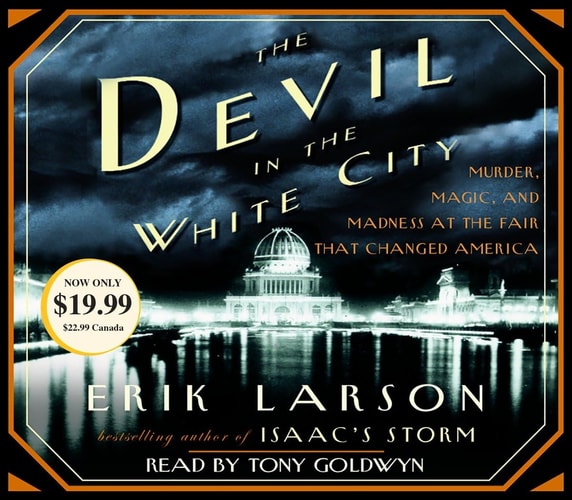
Two men, two visions, one city. In 1893, Chicago is set to host the magnificent World's Columbian Exposition, an event designed to showcase American ingenuity to the world. At the helm is Daniel H. Burnham, the brilliant and determined architect racing against time to erect a "White City" of unprecedented scale and beauty, a spectacle of light and order designed to change the way people see the world. But as millions prepare to flock to this dazzling fair, another man is also building a creation of his own, just blocks away. He is H. H. Holmes, a handsome and cunning doctor who has engineered a hotel specifically for his own dark purposes.
This work of narrative nonfiction interweaves the true stories of the visionary architect and the diabolical serial killer who operated in his shadow. As one man strives to create a symbol of progress and hope, the other uses the fair's massive crowds and the city's chaotic energy as a hunting ground, luring victims into his intricate "Murder Castle." This juxtaposition of ambition and malice, of architectural marvels and unimaginable horrors, reveals the startling contrasts of a nation on the cusp of a new century. It explores the heights of human achievement and the depths of its depravity, all set against the backdrop of an event that forever altered America.
The year is 1890, and Chicago, a city of ambition and grit, burns with a fierce desire to outshine its eastern rivals, particularly in securing the honor of hosting the World's Columbian Exposition. Into this crucible steps Daniel Hudson Burnham, a towering figure among architects, who, alongside his brilliant partner John Root, is tasked with an almost impossible feat: to conjure a grand, gleaming White City from the swampy expanse of Jackson Park in just over two years. The pressure is immense, a ceaseless torrent of logistical nightmares, financial woes, labor disputes, and the constant clash of ego among the era's greatest minds, including the temperamental Louis Sullivan and the visionary landscape architect Frederick Law Olmsted. Every nail driven, every beam raised, is a testament to an almost insane level of persistence, a collective dream to create a temporary utopia of beauty and innovation that will astonish the world.
Yet, as the White City begins to take form, a dazzling beacon of progress and enlightenment, a darker parallel narrative unfolds in the city's shadowy underbelly. Not far from the burgeoning fairgrounds, a charismatic and handsome doctor named H. H. Holmes arrives, a man whose charm is as disarming as his true intentions are sinister. He begins construction on his own architectural marvel: a three-story hotel, seemingly innocuous, but secretly a labyrinth of horror. With its soundproofed rooms, secret passages, trapdoors, chutes to the basement, and even a custom-built crematorium, this edifice, soon to be chillingly dubbed the "Murder Castle," is designed for one purpose only: to facilitate the vanishing of unsuspecting souls.
Burnham, a man driven by an almost spiritual devotion to his grand project, battles against the elements, the clock, and the sheer scale of his vision. He mourns the sudden death of his partner, John Root, a devastating blow, yet pushes forward with unwavering resolve. He oversees the erection of monumental, neoclassical structures, the installation of the world's first Ferris Wheel, and the meticulous landscaping that transforms a wilderness into manicured gardens and lagoons. The air crackles with invention and optimism, drawing inventors, artists, and eager visitors from across the globe, all preparing for the grand opening.
Meanwhile, Holmes, with a chilling nonchalance, preys on the vulnerable. The World's Fair brings a steady stream of young women to Chicago, seeking opportunity, excitement, or a fresh start, and Holmes is there to greet them. He lures them into his hotel with promises of employment or romance, his blue eyes and smooth demeanor masking a monstrous void. Guests check in, but few ever check out. Julia Conner, a trusting wife, and her daughter Pearl; Emeline Cigrand, a beautiful stenographer; Minnie Williams and her sister Nannie – they all fall under his spell, vanishing without a trace into the concealed depths of his custom-built death trap.
As the Fair opens its gates, a spectacle of light and wonder, drawing millions to its pristine avenues and magnificent buildings, the contrast between these two narratives becomes stark. The White City, a symbol of human aspiration and ingenuity, glows under electric lights, a temporary marvel of order and beauty. Yet, just beyond its carefully constructed façade, in the grimy, bustling 'Black City' of Chicago, Holmes continues his macabre work, exploiting the very anonymity and chaos that the Fair's immense crowds provide. The sheer volume of people makes disappearances easy to overlook, a needle lost in a haystack of ceaseless human traffic.
The Fair reaches its crescendo, a triumph of human will and collaboration, despite the tragic assassination of Chicago's beloved Mayor Carter Harrison just days before its close, casting a somber pall over the final celebrations. As the White City begins to dismantle, its temporary structures destined for demolition or decay, Holmes attempts to escape the consequences of his deeds. He sets his hotel ablaze for insurance money and flees Chicago, embarking on a nomadic spree of further deceptions and murders, including the horrific killing of Benjamin Pitezel and his children.
The net slowly tightens as insurance investigators and determined detectives, notably Frank Geyer, begin to unravel Holmes's tangled web of lies and disappearances. The trail, though circuitous and chilling, eventually leads to his capture and the horrifying discovery of his purpose-built murder fortress, a testament to his calculated depravity. The dream of the White City fades into memory, a bittersweet legacy of what humanity could achieve, while the chilling tale of its dark counterpart, the Murder Castle, forever stains the era, a stark reminder of the evil that can lurk unseen amidst the most dazzling displays of progress.
What other readers say
Liked
Many reviewers found the book to be a fascinating, engaging, and compelling read, frequently praising Erik Larson's exceptional storytelling ability. His writing style is often described as masterful, bringing the past vividly to life and making historical events feel immediate and intimate, almost like a novel. Readers appreciated the meticulous research and detailed information, noting the author's thoroughness in exploring his subjects. The book is widely lauded for its educational and informative qualities, successfully entertaining readers while broadening their understanding of the era. Specifically, the sections dedicated to the creation and operation of the 1893 World's Fair captivated many, with its grand vision, architectural marvels, and numerous innovations proving to be a highly interesting historical account.
Disliked
Despite its strengths, a common criticism centers on the book's structure and the perceived disconnect between its two primary narratives: the World's Fair and the story of a serial killer. Many reviewers felt these two threads were only abstractly related, leading to a sense that the book was "two separate books" rather than a cohesive whole. The alternating chapter format, intended to interweave these stories, often caused frustration, as readers reported being pulled away from one exciting narrative just as they became immersed. Some also found an imbalance in the focus, with the detailed accounts of the fair's planning and construction sometimes overshadowing the serial killer's story, which certain readers felt was relegated to a secondary role or became tedious to "slog through." A notable concern for some non-fiction purists was Larson's speculative approach, where details or scenes were presented as fact without clear distinction from confirmed historical records, leading to questions about the book's adherence to strict non-fiction standards.
In short
Ultimately, the book receives a generally positive, though often mixed, verdict, appreciated for its ambition and the sheer amount of historical information presented. While its unique narrative structure might not appeal to all, the book is highly recommended for history enthusiasts, particularly those interested in the Gilded Age, urban development, and the transformative impact of major events like the World's Fair. Readers who enjoy learning new facts and appreciate a non-fiction work that reads with the narrative drive of a novel, even if it incorporates some speculative elements, are likely to find it a compelling experience. However, those strictly seeking a pure true crime narrative focused solely on the "devil" aspect, or readers who prefer a rigorously unembellished historical account, might find their expectations unmet.
Twelve Years a Slave-Narrative of Solomon Northup: A Citizen of New-York, Kidnapped in Washington City in 1841, and Rescued in 1853, From a Cotton Plantation Near the Red River, in Louisiana