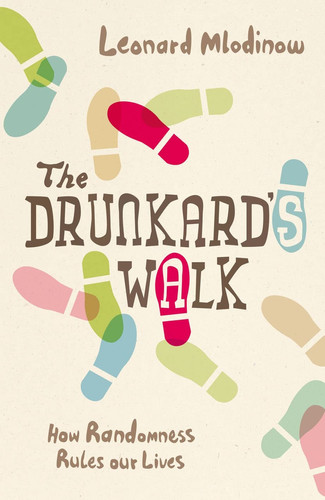
Positives Reviewers largely commend The Drunkard's Walk for its engaging and accessible exploration of randomness, probability, and statistics. Many appreciate how the author demystifies these often counterintuitive concepts without relying on complex equations, making the subject understandable for a broad audience. The book is praised for its fascinating historical narrative, detailing the development of mathematical thought on chance through interesting anecdotes about key figures. Readers found it informative and thought-provoking, highlighting its ability to reveal how randomness profoundly impacts various aspects of life, from personal achievements and business ventures to legal judgments and scientific studies. The numerous real-world examples and the author's compelling arguments about human biases are frequently cited as strong points.
Negatives However, some reviewers, particularly those with a solid background in mathematics or physics, felt that the book offered little new in terms of advanced concepts, finding much of the content too basic. Critics noted a perceived overemphasis on historical accounts at the expense of providing practical tools or deeper analytical insights, which left some readers wanting more substantial explanations. A few found the writing style to be dry or lacking a cohesive theme, describing it as a collection of disparate stories rather than a tightly integrated argument. One specific point of contention was the book's focus on a particular statistical distribution, with some wishing for a broader discussion of other relevant models. Additionally, some felt the book did not quite live up to the entertainment or provocative insights of other popular science titles.
Conclusion Despite these varied perspectives, The Drunkard's Walk is generally considered a valuable read for anyone seeking to better understand the role of chance in the world. It is particularly recommended for those without a strong mathematical background who are curious about probability and statistics, as it serves as an excellent and non-intimidating introduction. Readers who enjoy popular science, behavioral economics, or books that challenge preconceived notions about success, failure, and personal control will likely find it insightful. Ultimately, the book encourages readers to acknowledge the power of randomness, allowing for a more realistic outlook on life and a focus on persistence and controllable efforts amidst unpredictable outcomes.