
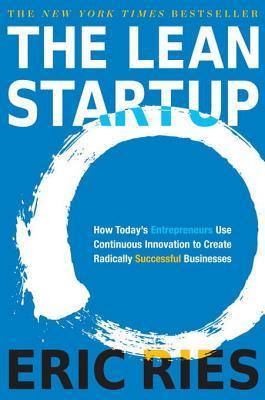
The Lean Startup
by Eric Ries
8.22 / 10 376K ratings
- Language
- English
- Published
- 2011
- Publisher
- Random House Publishing Group
- ISBN
- 9780307939838
Most startups fail. But many of those failures are preventable. The Lean Startup offers a systematic, scientific approach to creating and managing startups and new products in an age of extreme uncertainty. It provides a method to continuously test a vision, adapting and adjusting before it's too late. Rather than creating elaborate business plans, this approach is about rigorously testing your ideas through a cycle of building, measuring, and learning.
This book introduces a new way to manage businesses that is being adopted around the globe. It will teach you how to steer your startup, when to pivot, and when to persevere in the face of hard facts. By applying the principles of validated learning and innovation accounting, you can learn what your customers really want and build a sustainable business with maximum acceleration. It's an essential guide for entrepreneurs, innovators, and managers looking to navigate the foggy landscape of new venture creation.
This book introduces a new way to manage businesses that is being adopted around the globe. It will teach you how to steer your startup, when to pivot, and when to persevere in the face of hard facts. By applying the principles of validated learning and innovation accounting, you can learn what your customers really want and build a sustainable business with maximum acceleration. It's an essential guide for entrepreneurs, innovators, and managers looking to navigate the foggy landscape of new venture creation.
Subjects
- Reference
- Self-Help
- Business & Money
- Management & Leadership
- Leadership & Motivation
- Management
- Programming
- Business & Economics
- Business
- Industries
- Project Management
- Accounting
- Science
- Job Hunting & Careers
- Technology
- Python
- Entrepreneurship
- Guides
- Organizational Behavior
- Computers
- Leadership
- Business Development & Entrepreneurship
- Corporate Finance
- Starting a Business
- Small Business
- Development
- Encyclopedias
- Careers
- Internet
- Software Development & Engineering
- Computers & Information Technology
- E-Commerce
- Mentoring & Coaching
- Web Programming
- Applied Sciences
- Quality Assurance & Testing
- Business Development
- Web Services & APIs
- Mobile Devices
- Green Business
- Digital Marketing
- Online Trading
- Languages
- Nonfiction
- Startup
- Buisness
Other editions (72)




Listen to the summary Narrated summary
The traditional approach to launching new ventures - with elaborate business plans, extensive market research, and a grand unveiling - is fundamentally flawed for the uncertain world of startups. Instead, imagine a scientific methodology, a new way of thinking that allows you to navigate the fog of uncertainty and build radically successful businesses. This approach acknowledges that a startup is not merely a product or a company, but a human institution designed to create a new product or service under conditions of extreme uncertainty.
At the heart of this methodology lies the concept of validated learning: the process of demonstrating valuable truths about a business prospect through rigorous experimentation. Your goal isn't just to build a product, but to learn what customers truly want and whether a sustainable business can be built around that desire. This means every assumption about your product, services, prospective customers, and marketing campaigns should be treated as a hypothesis to be tested.
The core engine driving this learning is the Build-Measure-Learn feedback loop. First, you build a Minimum Viable Product (MVP) - the smallest version of your product that delivers value and allows you to gather the maximum amount of validated learning with the least effort. This isn't about creating something shoddy, but about focusing on the critical features that enable early testing.
Once your MVP is built, you measure how customers interact with it, collecting both qualitative and quantitative data. This data isn't just for vanity; it's for understanding actual customer behavior and the impact on your business. The aim is to move away from hypothetical strategic planning and unreliable surveys, towards real-world feedback.
The final step in the loop is to learn from the collected data. This learning informs whether you should "pivot" or "persevere." To pivot means to change your strategy, target market, or business model based on validated insights, while persevering means continuing with your current direction after confirming your hypotheses. This continuous iteration, driven by customer feedback, is the essential competitive advantage for any startup.
To measure progress effectively in this environment, a new form of accounting is necessary: innovation accounting. This system focuses on actionable metrics that reflect customer behavior and impact on the business, rather than misleading "vanity metrics" that offer little insight into true progress. It allows you to set learning milestones and objectively assess your development.
This scientific approach applies to all entrepreneurs, whether they are in small startups or large established organizations. It's a call to embrace continuous deployment, releasing small new features frequently to gather real-time feedback and accelerate the learning process. By doing so, you can reduce waste, generate innovation, and build an adaptive organization capable of thriving in a rapidly changing world. The ultimate goal is to engineer success by following a process that can be learned, taught, and continuously improved.
At the heart of this methodology lies the concept of validated learning: the process of demonstrating valuable truths about a business prospect through rigorous experimentation. Your goal isn't just to build a product, but to learn what customers truly want and whether a sustainable business can be built around that desire. This means every assumption about your product, services, prospective customers, and marketing campaigns should be treated as a hypothesis to be tested.
The core engine driving this learning is the Build-Measure-Learn feedback loop. First, you build a Minimum Viable Product (MVP) - the smallest version of your product that delivers value and allows you to gather the maximum amount of validated learning with the least effort. This isn't about creating something shoddy, but about focusing on the critical features that enable early testing.
Once your MVP is built, you measure how customers interact with it, collecting both qualitative and quantitative data. This data isn't just for vanity; it's for understanding actual customer behavior and the impact on your business. The aim is to move away from hypothetical strategic planning and unreliable surveys, towards real-world feedback.
The final step in the loop is to learn from the collected data. This learning informs whether you should "pivot" or "persevere." To pivot means to change your strategy, target market, or business model based on validated insights, while persevering means continuing with your current direction after confirming your hypotheses. This continuous iteration, driven by customer feedback, is the essential competitive advantage for any startup.
To measure progress effectively in this environment, a new form of accounting is necessary: innovation accounting. This system focuses on actionable metrics that reflect customer behavior and impact on the business, rather than misleading "vanity metrics" that offer little insight into true progress. It allows you to set learning milestones and objectively assess your development.
This scientific approach applies to all entrepreneurs, whether they are in small startups or large established organizations. It's a call to embrace continuous deployment, releasing small new features frequently to gather real-time feedback and accelerate the learning process. By doing so, you can reduce waste, generate innovation, and build an adaptive organization capable of thriving in a rapidly changing world. The ultimate goal is to engineer success by following a process that can be learned, taught, and continuously improved.
What other readers say
Liked
The Lean Startup is widely praised for introducing a transformative approach to entrepreneurship, particularly under conditions of extreme uncertainty. Reviewers highlight its core message that innovation can be counterintuitive, emphasizing the importance of continuous testing, experimentation, and learning as early and often as possible. The book clearly explains the Build-Measure-Learn feedback loop, actionable metrics, split-test experiments, and innovation accounting, drawing inspiration from Toyota's lean manufacturing principles. Many found the concept of a Minimum Viable Product (MVP) – focusing on the fastest way to learn rather than the smallest product – to be a crucial insight. Readers appreciate the author's clear, intellectually honest, and articulate writing style, with several noting how the book encourages a focus on customer needs and validated learning to avoid wasting time and resources on products nobody wants. It is seen as an inspirational guide that challenges traditional assumptions, promotes capital efficiency, and fosters an experimental mindset, making it a foundational text for the modern startup environment.
Disliked
Despite its strengths, some reviewers expressed frustration with The Lean Startup. A common criticism is that the book could be significantly shorter, with ideas often feeling repetitive or distilled with insufficient depth for practical application. Some readers expected more concrete "recipes" or detailed insights beyond the illustrative front-line stories, which primarily focus on the software industry. The book's tone was described by some as professorial or even condescending, potentially alienating readers. Concerns were also raised about the scientific rigor of the case studies presented, with some examples of "success" being based on what could be perceived as "vanity metrics" like venture funding rather than proven market success. Additionally, questions were posed regarding the universal applicability of the methodology, particularly for businesses outside of web services or those involving complex physical products and heavily regulated industries, where rapid iteration and prototyping might be more challenging.
In short
Overall, The Lean Startup is considered a massively important and highly acclaimed book that has significantly influenced the entrepreneurial landscape. While it may not offer all the "how-to" answers and some concepts might require further research or critical interpretation, its fundamental principles are widely regarded as invaluable. This book is strongly recommended for aspiring entrepreneurs, startup founders, managers within established companies looking to foster innovation, and anyone interested in agile management or product development. It serves as a powerful "building block" for understanding how to approach new ventures by focusing on disciplined processes, continuous learning, and customer validation. Readers willing to engage with its core ideas and apply them in practice, even if adapted to their specific industry, will likely find it an enlightening and motivating read that fundamentally shifts their perspective on building successful products and businesses.
No reviews yet. Be the first.