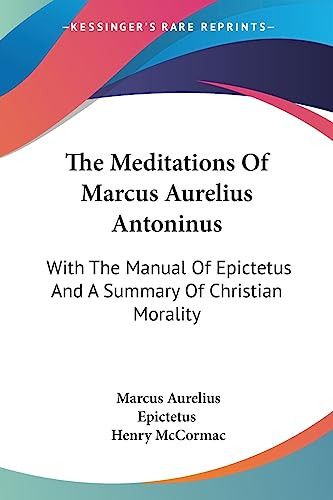
The Meditations Of Marcus Aurelius Antoninus: With The Manual Of Epictetus And A Summary Of Christian Morality
8.54 / 10 382K ratings
- Language
- English
- Published
- 2007
- Publisher
- Kessinger Publishing, LLC
- Pages
- 128
- ISBN
- 9781430491545
Written by a Roman emperor for his own personal guidance, these private reflections were never intended for publication. What resulted is one of the most influential works of Stoic philosophy, a collection of spiritual exercises and insights developed as one of history's most powerful leaders struggled to understand himself and the universe. The Meditations of Marcus Aurelius offer a direct line into the mind of a man grappling with virtue, mortality, and the nature of human rationality while navigating war, plague, and personal responsibility.
This is not a dense philosophical treatise, but a series of practical aphorisms and straightforward thoughts on how to live. Aurelius provides timeless guidance on maintaining inner peace in the face of adversity, focusing on what is within our control, and living a life of purpose and integrity. For nearly two thousand years, these writings have been a source of consolation and wisdom for statesmen, thinkers, and anyone seeking to cultivate resilience and a more meaningful existence. It is an essential guide to the art of living, offering a profound understanding of human behavior and a path toward tranquility.
This is not a dense philosophical treatise, but a series of practical aphorisms and straightforward thoughts on how to live. Aurelius provides timeless guidance on maintaining inner peace in the face of adversity, focusing on what is within our control, and living a life of purpose and integrity. For nearly two thousand years, these writings have been a source of consolation and wisdom for statesmen, thinkers, and anyone seeking to cultivate resilience and a more meaningful existence. It is an essential guide to the art of living, offering a profound understanding of human behavior and a path toward tranquility.
Subjects
- Travel
- General
- Reference
- Literature & Fiction
- Europe
- Subjects
- Literary
- Self-Help
- Health, Fitness & Dieting
- Action & Adventure
- Historical
- History
- Biographies & Memoirs
- Leaders & Notable People
- Science & Math
- Education & Teaching
- Schools & Teaching
- Body, Mind & Spirit
- Romance
- Memoirs
- Political
- Greece
- Family Life
- Religion & Spirituality
- Inspirational
- Stress Management
- Essays
- New Age & Spirituality
- Essays & Correspondence
- Education Theory
- Science Fiction
- Psychological
- Politics & Social Sciences
- Philosophy
- Consciousness & Thought
- Specialty Boutique
- New, Used & Rental Textbooks
- Foreign Language Study & Reference
- Social Sciences
- Fiction
- Biography & Autobiography
- Religious
- Personal Growth
- Professionals & Academics
- Alternative Medicine
- Classics
- Mental & Spiritual Healing
- Fiction, historical, general
- Education
- American fiction (fictional works by one author)
- Description and travel
- Literary Collections
- Women
- Religious Studies
- Conduct of life
- Meditation
- SELF-HELP TECHNIQUES
- History & Criticism
- Antiques & Collectibles
- Religion
- Classic Literature
- Ancient & Medieval Literature
- Ancient & Classical
- Audio Adult: Other
- Foreign Language Study
- Greek & Roman
- Gothic
- Eastern
- Spirituality
- Personal Memoirs
- History & Philosophy
- Movements & Periods
- CONDUCT OF LIFE
- Movements
- PHILOSOPHY
- Literary Criticism
- Ethics
- Marriage & Divorce
- Letters
- Meditations
- History & Schools of Thought
- Mindfulness & Meditation
- Good & Evil
- Self-help techniques
- Fiction, psychological
- ETHICS
- Ancient Civilizations
- Rome
- Medieval
- City Life
- Mind & Body
- Philosophers
- Bargain Books
- Ethics & Moral Philosophy
- Philosophy, Theory & Social Aspects
- Ancient
- Ethics & Morality
- Unabridged Audio - Inspirational/Philosophy
- History & Surveys
- MEDITATIONS
- AUTHORS_CORRESPONDENCE
- Early works to 1800
- Latin
- Ancient & Classical History
- Descriptions et voyages
- Individual Philosophers
- Life
- Correspondence
- Inspirational - General
- Emperors
- Charities
Original edition
MeditationsOriginally published in 1800 English HACHETTE INDIA
Other editions (119)



Listen to the summary Narrated summary
From the quiet solitude of my own thoughts, amidst the clamor of empire and the chill of military campaigns, these words flow forth, a constant dialogue with myself, a series of reminders to hold fast to what is true and eternal. Each reflection is an anchor, tethering my soul to the bedrock of reason and virtue in a world of ceaseless flux. I find solace in the conviction that the universe is an ordered whole, governed by a divine reason, a Logos that permeates all things. To live in harmony with this nature, to accept its unfolding with grace, is the highest good.
Consider the fleeting nature of all things, the relentless current of time that sweeps away empires, generations, and even the memory of great deeds. What is fame but a breath, a ripple on the surface of an endless ocean? To crave it, or to fear its loss, is to cling to shadows. All that exists is destined to change, to be transformed, to perish, so that new things may be born. This constant cycle, this grand, inevitable dance of creation and decay, is not a cause for sorrow but a call to embrace the present moment, for it is all we truly possess. Let not the past trouble you, nor the future cause anxiety; live fully in this breath, this unfolding instant.
The true battlefield, I discover, lies not in distant lands against barbarian hordes, but within the confines of my own mind. External events, the actions of others, the sting of misfortune – these hold no inherent power to harm me. It is my judgment, my interpretation, my reaction to these things that dictates my suffering. If I can train my mind to perceive objectively, to strip away the layers of opinion and emotion, then I can stand firm, an unassailable fortress against the slings and arrows of outrageous fortune. Here lies true freedom: the power to choose my attitude, to control my inner citadel, regardless of the chaos that rages without.
And what of others, those fellow travelers on this brief journey? Their misdeeds, their ignorance, their follies – they are but reflections of their own struggles, acting often against their own will. To be vexed by them is to act contrary to nature, for we are all interwoven, parts of a single, rational whole. Compassion, patience, and a steadfast commitment to justice are the virtues that bind us. Do not expect perfection from others, but rather strive to embody it yourself, understanding that our common humanity demands empathy and a willingness to forgive, even as we seek to guide them gently towards the good.
My duty, therefore, is clear: to act in accordance with nature, to serve the greater good, to be a good man in every moment. This is not a grand, theoretical pursuit, but a daily practice of humility, self-control, and unwavering resolve. Each day presents opportunities to exercise these virtues, to confront fears, to temper desires, to align my will with the universal reason. Though the path may be arduous, and the temptations to stray ever-present, the strength lies within, a lasting fountain of happiness that bubbles up if only I choose to dig for it.
Death, that ultimate cessation, is not to be feared. It is a natural process, as inevitable as birth, a dispersion of atoms or a transition into the universal reason, depending on how one conceives of the cosmos. To live as if you had endless years ahead is a grave delusion. Death overshadows you. While you are alive and able, be good. Live each day as if it were your last, not with reckless abandon, but with profound purpose, mindful of your responsibilities, and accepting of your place in the grand design. The longest and shortest life will end the same way, dissolved into the same eternity. What matters is not its duration, but how virtuously it was lived.
Consider the fleeting nature of all things, the relentless current of time that sweeps away empires, generations, and even the memory of great deeds. What is fame but a breath, a ripple on the surface of an endless ocean? To crave it, or to fear its loss, is to cling to shadows. All that exists is destined to change, to be transformed, to perish, so that new things may be born. This constant cycle, this grand, inevitable dance of creation and decay, is not a cause for sorrow but a call to embrace the present moment, for it is all we truly possess. Let not the past trouble you, nor the future cause anxiety; live fully in this breath, this unfolding instant.
The true battlefield, I discover, lies not in distant lands against barbarian hordes, but within the confines of my own mind. External events, the actions of others, the sting of misfortune – these hold no inherent power to harm me. It is my judgment, my interpretation, my reaction to these things that dictates my suffering. If I can train my mind to perceive objectively, to strip away the layers of opinion and emotion, then I can stand firm, an unassailable fortress against the slings and arrows of outrageous fortune. Here lies true freedom: the power to choose my attitude, to control my inner citadel, regardless of the chaos that rages without.
And what of others, those fellow travelers on this brief journey? Their misdeeds, their ignorance, their follies – they are but reflections of their own struggles, acting often against their own will. To be vexed by them is to act contrary to nature, for we are all interwoven, parts of a single, rational whole. Compassion, patience, and a steadfast commitment to justice are the virtues that bind us. Do not expect perfection from others, but rather strive to embody it yourself, understanding that our common humanity demands empathy and a willingness to forgive, even as we seek to guide them gently towards the good.
My duty, therefore, is clear: to act in accordance with nature, to serve the greater good, to be a good man in every moment. This is not a grand, theoretical pursuit, but a daily practice of humility, self-control, and unwavering resolve. Each day presents opportunities to exercise these virtues, to confront fears, to temper desires, to align my will with the universal reason. Though the path may be arduous, and the temptations to stray ever-present, the strength lies within, a lasting fountain of happiness that bubbles up if only I choose to dig for it.
Death, that ultimate cessation, is not to be feared. It is a natural process, as inevitable as birth, a dispersion of atoms or a transition into the universal reason, depending on how one conceives of the cosmos. To live as if you had endless years ahead is a grave delusion. Death overshadows you. While you are alive and able, be good. Live each day as if it were your last, not with reckless abandon, but with profound purpose, mindful of your responsibilities, and accepting of your place in the grand design. The longest and shortest life will end the same way, dissolved into the same eternity. What matters is not its duration, but how virtuously it was lived.
What other readers say
Liked
Many readers laud "Meditations" as a profound and timeless source of wisdom, offering practical guidance for living a well-examined life. Reviewers consistently praise its ability to distill complex philosophical ideas into accessible advice, making it a powerful tool for personal growth and self-improvement. The book is celebrated for its insights into developing self-discipline, cultivating inner strength, and achieving a quiet mind, which many find incredibly relevant to modern challenges. Its enduring nature, having resonated with readers for nearly two millennia, is frequently highlighted as a testament to its universal appeal and the relatable humanity of its author, Marcus Aurelius, as he grapples with universal struggles like mortality and the pursuit of meaning. For many, it serves as an excellent introduction to Stoic philosophy, inspiring a more thoughtful and principled approach to life.
Disliked
Despite its revered status, "Meditations" is not without its criticisms. The most common complaint among readers is its repetitive nature, with many finding the same core ideas reiterated frequently throughout the text. This can lead to a sense of tedium or a feeling that the book lacks sustained development of its concepts. Some reviewers also note that while the advice is sound, it may not feel particularly novel to those who have already encountered similar self-help or philosophical principles elsewhere. The book's significant focus on themes of death and the transient nature of existence, while central to its philosophy, does not resonate with all readers. Additionally, a few comments touch on the perceived irony of an emperor dispensing advice on humility and detachment while wielding immense power, or find certain philosophical tenets like determinism unconvincing. Its original format as a personal journal, not intended for publication, also contributes to its unpolished structure, which some find less engaging as a conventional read.
In short
Ultimately, "Meditations" is widely regarded as an indispensable classic in philosophical literature, though it is acknowledged that its unique style may not appeal to everyone. Its strength lies in its capacity to offer deep insights into human nature and the pursuit of virtue, making it a foundational text for understanding Stoicism. Readers suggest that the book is best approached not as a linear narrative but as a collection of reflections to be savored slowly, perhaps dipped into daily for contemplation and inspiration. It is highly recommended for individuals seeking practical wisdom for self-mastery, emotional resilience, and a more purposeful existence. Those interested in ancient philosophy, particularly Stoicism, and anyone looking for a profound guide to living a dignified and thoughtful life, will likely find immense value and enduring lessons within its pages.
No reviews yet. Be the first.