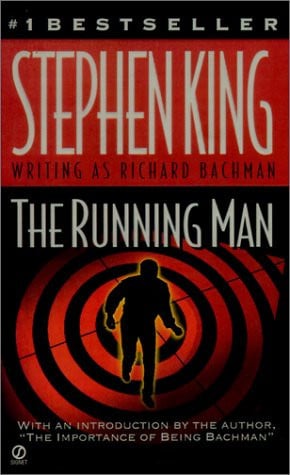
The Running Man
- First published 1981
- 400 pages
- English
An arrogant and overweight lawyer, Billy Halleck, lives a comfortable life with his wife and daughter. After celebrating his acquittal of a client in a drunk driving case, he accidentally hits and kills an old woman from a traveling Romani caravan. Using his connections in the legal and police systems, Halleck is absolved of any wrongdoing. The woman's ancient father, however, places a curse on him by touching his cheek and whispering a single word: "thinner."
Suddenly, Halleck begins to lose weight at an alarming and uncontrollable rate. What at first seems like a blessing soon reveals itself to be a terrifying, wasting affliction. As his body deteriorates and his life spirals out of control, he discovers that the judge who presided over his case and the police officer who committed perjury are also suffering from grotesque, seemingly supernatural curses. Halleck must now race against time to find the old man and persuade him to lift the curse before there is nothing left of him. This story explores the nature of justice and the terrifying consequences of evading responsibility.
- Genres
- Fiction › Thriller & suspenseFiction › Speculative fiction › Science fictionFiction › Speculative fiction › FantasyFiction › Crime & mysteryFiction › Speculative fiction › Horror & supernatural › Occult horror
- Themes
- Mythical & supernatural beingsArt & creativity › Books & readingClass & money › WorkScience & technology › GeneticsArt & creativity › Writers & writing
- Where and when
- New York City Ohio Vermont Washington, D.C.
What readers say
3.78
233K ratings across the web 6 in 10 readers loved it, 1 didn't like it
Reviewers widely praise The Running Man for its relentless, fast-paced action and thrilling narrative that keeps readers on the edge of their seats, often leading to the book being devoured in a single sitting. Many highlight its remarkably prescient vision of a dystopian future, accurately anticipating the rise of reality television, extreme social inequality, and the manipulative power of media propaganda decades before they became prevalent. The novel is lauded for its dark, hardcore dystopian atmosphere and its strong social commentary, which uses allegories and exaggerations to critique societal flaws. Readers also appreciate the raw and unbridled style characteristic of Stephen King's work under his Richard Bachman pseudonym, finding it a gripping and original take on the manhunt trope.
However, the book is not without its criticisms. Some reviewers find certain aspects of the novel, particularly its commentary on various social groups, to be dated and potentially offensive by modern standards. The rapid pace, while exciting for many, sometimes comes at the expense of character depth, with the protagonist often described as surface-level or unlikable beyond his primary motivations. A few readers felt the plot relied too heavily on convenience or lacked sufficient world-building explanations, making it hard to fully immerse themselves. A frequently mentioned issue is the foreword by Stephen King in some editions, which unfortunately contains significant spoilers for the ending, detracting from the suspense for unsuspecting readers.
Despite these points, The Running Man is largely considered a compelling and significant early work in the dystopian thriller genre. It offers a gripping, action-driven story that, while sometimes brutal and bleak, effectively explores themes of desperation, survival, and media control. This book is highly recommended for readers who enjoy intense, fast-paced dystopian fiction with strong social criticism, especially those interested in stories that challenge societal norms and explore the darker aspects of human nature and entertainment. However, new readers should be cautious to avoid the foreword if they wish to experience the ending unspoiled.
Reviews
No reviews yet. Be the first.
Details & editions
- This edition
- Scribner, 2016
- ISBN
- 9781501141355
- Language
- English
Original edition Ojos de fuego Originally published in 1981 · Spanish · Editorial Pomaire