Add to library
You don't have any lists yet. Create one in My Library.
Go to My LibraryAdd to library
You don't have any lists yet. Create one in My Library.
Go to My LibraryThe Shopkeeper A Steve Dancy Tale
- Language
- English
- Published in
- Publisher
- Center Point Pub.
- Pages
- 317
- ISBN
- 9781602855724
Told in a plainspoken and authentic voice, this true-life novel chronicles Lily's journey through natural disasters, the Great Depression, and personal tragedy without ever breaking her spirit. She faced droughts, floods, and deep-seated prejudice with an unyielding pragmatism and a fierce independence. Half Broke Horses is not just the story of one woman's remarkable life; it is an encounter with an unforgettable character whose resourcefulness and sheer grit offer a powerful testament to the strength of the human will. It is an exploration of a life that refused to be tamed.
Subjects
Original edition details
Other editions (10)
Other editions
Half Broke Horses
2010 • Pocket Books
English
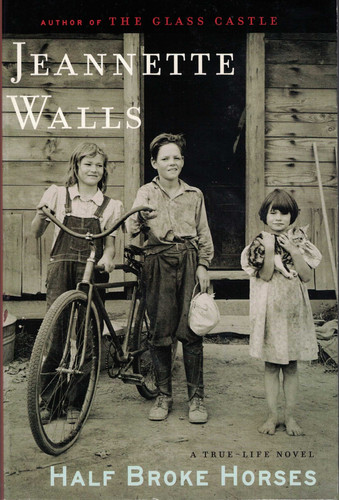
Half Broke Horses A True-life Novel
2009 • Scribner
English
Half Broke Horses
2009 • Simon & Schuster
English

Half Broke Horses
2011 • Thorpe
English
Half Broke Horses Hauptbd.
2013 • Diesterweg
English
Half Broke Horses: A True-Life Novel
2019 • Simon & Schuster Audio
English

Half Broke Horses
2010 • Perfection Learning Corporation
English
Half Broke Horses: A True-Life Novel
2012 • Klett Sprachen GmbH
German
Half Broke Horses: A True-Life Novel
2009 • Recorded Books
English

Half Broke Horses
2009 • Simon and Schuster
English
Life in west Texas was hard country, a place for tough nuts like me and Dad. We lived in a dugout carved into the riverbank, a place cool in the summer but prone to snakes dropping from the ceiling. Dad, with his gimp leg from a horse kick and his garbled speech, was a brilliant man who trained carriage horses and wrote long letters to politicians about phonetic spelling. Mom was a lady, concerned with proprieties and her velvet curtains, who fainted from lacing her corsets too tight and refused to do manual labor. When another flood finally collapsed our dugout, we salvaged lumber from a neighbor who'd had enough and built a proper wooden house. But then a tornado tore the place to shreds, and Dad decided it was time to leave Texas and return to the family's KC Ranch in New Mexico.
The KC Ranch was so green I could hardly believe it. But Dad, consumed with writing a biography of Billy the Kid and pursuing harebrained schemes, left the running of the place to me. He and Mom had promised I could go to school, and at thirteen, they sent me to the Sisters of Loretto in Santa Fe. It felt like a long vacation, a world of order and learning where I won gold medals for scholarship. But my joy was short-lived. Dad wrote the school that he couldn't assemble the funds for my tuition. He'd spent the money on four Great Danes he planned to breed. I was sent home on a stagecoach, my one shot at an education seemingly blown. As Mother Albertina, the Mother Superior, saw me off, she took my hand. “When God closes a window,” she said, “he opens a door. But it's up to you to find it.”
Back on the ranch, Dad's dogs were shot dead by our neighbor, Old Man Pucket, for chasing his cattle. Dad wanted to kill him, but I helped talk him down. At the hearing, I spoke for our family, and though the judge sided mostly with Pucket, he ordered him to give us eight of his half-broke horses in compensation. One of them, a smart pinto mare I named Patches, was all mine. It was on Patches that I set out alone at fifteen, riding five hundred miles to Arizona after Mother Albertina sent word of a teaching shortage. For three years, I was the mustang-breaking, poker-playing schoolmarm of Coconino County, moving from one remote town to the next, until the war ended and I was told my services were no longer needed.
I returned to the ranch, but it was no longer my place. I struck out for Chicago, a city of soaring skyscrapers and endless blue water. I worked as a maid, scrubbing floors for women who treated me like I was invisible, and went to school at night. I fell for a fast-talking vacuum-cleaner salesman named Ted Conover, a man with the gift of gab and a diamond ring he'd gotten through “connections.” We were married, saving for a future he told me was full of promise. But after a roadster knocked me off my feet, a call to his office revealed the truth: his wife's name was Margaret. He had a whole other family. I shattered the frosted glass on his office door with my purse and threw his fake diamond ring into the lake.
I came back to Arizona with a high school diploma and a plan to get my college degree. I found a teaching job in Red Lake, the first town I'd ever taught in. I raced horses, won purses, and bought a brilliant red silk shirt that became my trademark. I met a man there named Jim Smith, a big, quiet rancher twenty years my senior who'd been a lumberjack, a prospector, and a cavalryman in Siberia. He was the son of the great Mormon pioneer Lot Smith, and he was as solid and dependable as the mountains. I wasn't looking to marry again, but then my sister Helen arrived from Hollywood, her dreams broken, her hair peroxided, and her belly swollen with the child of a man who'd abandoned her. When the townspeople and the school superintendent turned on us, Helen fell into despair. One morning, I returned to our little teacherage to find she had hanged herself from a rafter. We buried her out on the range, in my red silk shirt.
The pain of Helen's death laid on me like a slab of lead, but I knew I had to go on. I asked Jim Smith to marry me, and we moved to the town of Ash Fork, where we built a sandstone house and a garage on Route 66. The Depression hit hard, and to make ends meet, I started selling bootleg liquor out the back door. But the bank foreclosed anyway, and just as we were about to auction everything off, we were offered the job of managing a 180,000-acre ranch for a group of English investors. We moved there with our two children, Rosemary and Little Jim, and when a drought nearly wiped us out, I had the idea to bring in a bulldozer - the first in those parts - to build a massive dam that would trap the rainwater. The pond it created was the finest body of water I'd seen since Lake Michigan, and everyone called it Big Jim.
For eleven years, that ranch was our life. I went back to teaching, driving the kids to a one-room school in a converted hearse I'd painted SCHOOL BUS on the side. I took on local authorities, from a polygamous elder in the Arizona Strip to a corrupt deputy, and got fired more times than I can count. I took flying lessons, hoping to become a crop duster. I finally got my college degree in Phoenix while the kids were away at boarding school, but they hated being penned in and were as half-broke as the horses we raised. When the English investors sold the ranch to a Hollywood director who wanted to “goose the magic” with knotty pine, we were fired and forced to leave the only real home we'd ever known.
We moved to Phoenix, a city of locked doors and air-raid sirens that made us all feel puny and penned in. Jim took a desk job in a warehouse, and I taught in a city high school full of bureaucrats and spoiled kids. Rosemary, now a teenager, was a wild-hearted artist who dreamed of the ranch and argued with me about everything from the atom bomb to God. She fell for a flyboy named Rex Walls, a charming, hard-drinking hellion from West Virginia who was all talk and grand plans. He was the last man on earth I would have chosen for her. “You need an anchor,” I told her. “The problem with being attached to an anchor,” he told me, “is it's damned hard to fly.”
Rosemary married him anyway. I threw them a grand wedding at a fancy hotel, and Jim and I watched them drive off, heading out into open country like a couple of half-broke horses. They drifted around the desert, having babies and living hand-to-mouth on Rex's harebrained schemes. The third was a scrawny girl with my square jaw and smiling green eyes. When I held her, the little critter grabbed my finger and held on like she'd never let go. Her name was Jeannette. I knew her life would be a wild ride, but she came from hardy stock. And I'd be hovering around. I still had a few things to teach those kids, and there wasn't a soul alive who could stop me.
No discussions yet for this book.
Delete Discussion
Are you sure you want to delete this discussion? This action cannot be undone.
Rating Sources
Reviewers largely praise Jeannette Walls' "Half Broke Horses" for its compelling portrayal of her grandmother, Lily Casey Smith, an unforgettable and truly remarkable character. Lily is consistently described as a woman of immense strength, determination, and resilience, a "real-life superhero" with abundant "gumption" who faced life's challenges head-on. Readers were captivated by her adventurous spirit, from breaking horses as a child to teaching in remote schoolhouses, piloting a plane, and running a ranch in the early 1900s American Southwest. The book is celebrated for vividly bringing to life a forgotten era of American history, depicting the hardscrabble ranching life and the vast, untamed landscapes with an engaging and artistic writing style that many found easy to read and absorbing. Walls' ability to capture Lily's distinct, no-nonsense voice and infuse the narrative with humor and wisdom was a particular highlight, drawing readers deeply into the story and making them feel part of a bygone time. For fans of "The Glass Castle," this book is also highly valued for providing crucial insights into the background and influences that shaped Walls' mother, Rosemary.
Despite widespread admiration, some reviewers found "Half Broke Horses" to be less consistently engaging than expected, with a few noting that the narrative's second half or early sections lost their initial momentum. While Lily's strength was admired, some readers found her character at times unlikable, perceiving her as overly self-interested, unwilling to admit fault, or lacking in kindness and compassion, which made her difficult to connect with. A significant point of contention for some was the book's designation as a "true-life novel." Several reviewers expressed disappointment and even frustration upon discovering perceived historical inaccuracies or significant "liberties" taken with family stories, feeling that the book leaned more towards fiction "inspired by" events rather than a strictly factual account. This led to a sense that the narrative lacked the raw authenticity expected from a story based on real lives. Additionally, some felt the book didn't quite live up to the high standard set by "The Glass Castle," describing it as less compelling, lacking the same emotional depth, or wishing for more dramatic intrigue and character development to elevate it beyond a collection of anecdotes.
Overall, "Half Broke Horses" is generally regarded as a worthwhile and enjoyable read, particularly for its vibrant depiction of an indomitable woman and a fascinating period of American history. It is highly recommended for readers who appreciate narratives about strong female characters, tales of resilience against hardship, and a glimpse into the early 20th-century American West. Fans of Jeannette Walls' previous work, especially "The Glass Castle," will likely find this book a valuable companion, offering a deeper understanding of the family's lineage and the origins of its distinctive characters. While some suggest reading it before "The Glass Castle" for contextual benefits, others see it as a compelling prequel. Despite the debates over its genre and occasional criticisms of pacing or character depth, the book largely succeeds in transporting readers to a different time and celebrating a truly unique life.
No reviews yet. Be the first to review this book!
Delete Review
Are you sure you want to delete this review? This action cannot be undone.