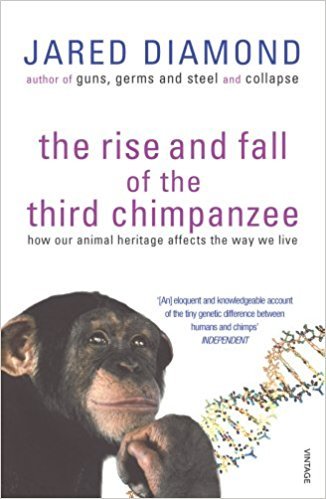
The Third Chimpanzee: The Evolution and Future of the Human Animal
- First published 1991
- 407 pages
- English
Jared Diamond explores the paradox of humanity, a species that shares over 98% of its genes with chimpanzees, yet has forged civilizations, developed complex languages, and reshaped the planet. This book delves into the evolutionary journey of *Homo sapiens*, examining the subtle genetic differences that led to the emergence of our unique traits, from abstract thought and art to technology and intricate social structures.
Drawing on diverse fields such as anthropology, biology, and history, Diamond investigates the origins of human behavior, including our sexuality, cultural development, and the darker aspects of our nature, such as violence and environmental destruction. The narrative offers a comprehensive look at how humans ascended to global dominance and the critical implications this trajectory holds for our future.
What readers say
4.09
29K ratings across the web 8 in 10 readers loved it
The reviews highlight Jared Diamond's The Third Chimpanzee as a highly engaging and accessible exploration of human evolution and behavior. Readers praise its broad scope, covering a vast array of topics from our genetic links to other primates and the development of language and culture, to the origins of human sexuality, art, and societal structures. The book is lauded for its ability to present complex scientific facts and intriguing theories in a readable and understandable manner, making it an excellent entry point for laypersons into evolutionary biology and anthropology. Many found it thought-provoking, offering fresh insights that stimulate conversation and challenge preconceived notions about humanity's place in the natural world. Furthermore, it is often seen as a foundational work, laying the groundwork for many themes that Diamond would expand upon in his subsequent, more famous books.
Despite its strengths, the book receives criticism for several aspects, primarily its age. Published in the early 1990s, some scientific information and theories presented are now considered outdated or have been superseded by more recent research, particularly concerning genetics, early human species, and astronomy. Reviewers also point to instances where Diamond is perceived to overstep his expertise, making broad generalizations or relying on speculation and cherry-picked data rather than a comprehensive scientific consensus. Specific theories, such as those on drug addiction or the origins of art, are questioned for their plausibility or reductionist approach. Some find the book repetitive, noting that many of its themes are revisited in more detail in Diamond's later works, which can diminish the sense of novelty for readers already familiar with his other writings. A few critics also express discomfort with certain anthropological perspectives presented, feeling they can sometimes unintentionally objectify or misrepresent indigenous cultures.
Overall, The Third Chimpanzee is considered a valuable and stimulating read, often described as a compelling overview of humanity's evolutionary journey and its impact on the planet. While acknowledging its dated aspects and occasional speculative arguments, many reviewers still recommend it as an excellent introduction to Diamond's work and the broader field of human origins. It is particularly suited for readers with a curious bent, those interested in evolutionary theory, human history, and our relationship with other life forms and the environment. The book prompts readers to reflect on human behavior, both positive and destructive, and serves as a timely reminder of our responsibilities towards the planet. It is seen as a stepping stone for deeper exploration into anthropological non-fiction, offering a robust framework for understanding what it means to be human.
Reviews
No reviews yet. Be the first.
Details & editions
- This edition
- Harper Perennial, 2006
- ISBN
- 9780060845506
- Language
- English
Original edition The Rise and Fall of the Third Chimpanzee Originally published in 1991 · English · Radius-Verlag GmbH