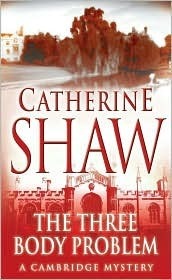
The Three Body Problem
- First published 2004
- 288 pages
- English
In 1888 Cambridge, schoolmistress Vanessa Duncan finds her world of academia disrupted by a series of perplexing murders. When a Fellow of Pure Mathematics is found dead, the investigation uncovers a connection to Sir Isaac Newton's unsolved "n-body problem" and a prestigious prize that drives the university's brightest minds.
As more mathematicians fall victim and her blossoming relationship with Arthur Weatherburn, a fellow mathematician, becomes entangled in the escalating crimes, Vanessa is compelled to apply her own sharp intellect to the puzzle. Convinced of Weatherburn's innocence after his arrest, she races against time to decipher the mathematical motive behind the killings and prevent further tragedy. This historical mystery invites readers into a world where academic ambition and deadly secrets intertwine, challenging them to solve a complex enigma rooted in the very fabric of mathematical pursuit.
What readers say
3.27
379 ratings across the web 4 in 10 readers loved it, 2 didn't like it
Many reviewers praise the book's unique premise and setting, particularly its portrayal of Cambridge in 1888. The mystery, which centers around the deaths of mathematicians and involves complex mathematical concepts, is described as unusual, compelling, and intellectually stimulating, often drawing comparisons to the deductive logic of Sherlock Holmes. Readers appreciated the inclusion of puzzles, problems, and literary quotes, which not only served as diversions but also played a crucial role in the plot. The historical context, including the challenges faced by women in education during the era, was also a significant positive, providing an instructive layer to the narrative. The protagonist, Vanessa Duncan, is frequently highlighted as a likable, kind, and determined character whose efforts to solve the mystery and seek justice resonated with many.
However, the book's epistolary style, told solely through Vanessa's one-sided letters to her twin sister, was a frequent point of contention. Many found this format clunky and unrealistic, questioning the protagonist's ability to recall verbatim conversations and the believability of her sister receiving such extensive missives. The pacing was another common criticism, with some reviewers finding the initial chapters slow or tedious, and the courtroom scenes overly long and dragging. Concerns were also raised about historical inaccuracies, such as the mention of fingerprints in 1888, and elements of the plot that stretched credulity, including the protagonist's travels and the speculative nature of her courtroom testimony. Some readers also felt the protagonist was at times naive or slow to grasp obvious plot points, and that there was an excessive amount of mathematical detail that wasn't always essential to the storyline.
Despite its narrative quirks and occasional plot contrivances, many reviewers found the book to be an enjoyable and engaging read, especially as the plot progressed and accelerated towards a satisfying, if at times fanciful, conclusion. It is generally recommended for readers who appreciate historical mysteries set in the Victorian era, particularly those with a strong academic or mathematical bent. Fans of cozy mysteries, historical fiction, and those who enjoy a unique narrative style and a likable, if sometimes naive, amateur sleuth, are likely to find this book appealing. While not considered a complex masterpiece by all, it offers an entertaining and often charming journey into a bygone era, ideal for those willing to embrace its distinctive approach and overlook its minor imperfections.
Reviews
No reviews yet. Be the first.
Details & editions
- This edition
- Allison & Busby, 2005
- ISBN
- 9780749083472
- Language
- English
Original edition The Three-Body Problem Originally published in 2004 · English · Allison & Busby