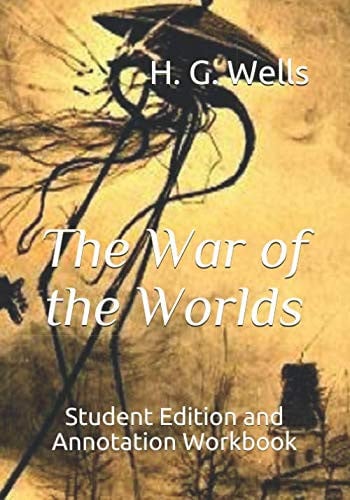
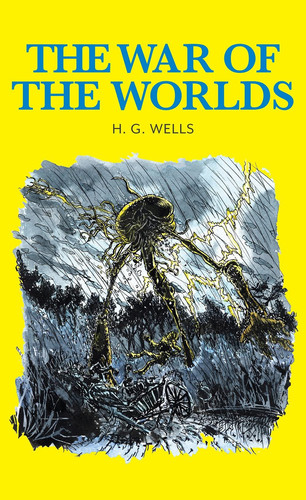
In the quiet English countryside at the turn of the nineteenth century, humanity believed itself the undisputed master of its domain. That illusion is shattered when strange, cylindrical objects fall from the sky, disgorging Martian invaders. What begins as scientific curiosity quickly turns to terror as the technologically superior aliens unleash devastating heat-rays and towering tripod fighting machines, laying waste to everything in their path. The narrative follows an unnamed protagonist through the heart of a collapsing civilization, a firsthand account of humanity's desperate and seemingly futile struggle for survival against an utterly ruthless and overwhelming force.
This foundational work of science fiction chronicles the catastrophic conflict between two species, but it also explores deeper questions of imperialism, evolution, and mankind's true place in the universe. As the invaders methodically dismantle the pinnacle of human empire, the story forces a reconsideration of what it means to be dominant and what it means to be conquered. It is a stark and unflinching look at the fragility of society in the face of an existential threat, offering a timeless and chilling tale of invasion and survival.
No one could have foreseen it. For months, the astronomers had spoken of strange lights on Mars, faint flashes that hinted at something beyond our comprehension. Yet, the complacent world of late Victorian England dismissed these observations as mere scientific curiosity, believing humanity to be the undisputed master of its own destiny. My own philosophical musings in the quietude of Surrey were abruptly shattered one summer evening by a falling star, a vast cylinder plummeting from the heavens onto Horsell Common.
A gathering crowd, myself among them, watched with a mixture of awe and trepidation as the cylinder's lid slowly unscrewed. What emerged was not the fantastical creature of childish nightmares, but something far more alien and terrifying: large, grey, glistening bodies, with huge, luminous eyes and a writhing mass of tentacular appendages. Then came the Heat-Ray, an invisible, searing beam that swept across the common, incinerating everything in its path with horrifying efficiency. The initial curiosity of the villagers turned to utter panic as the Martians, encased in colossal, three-legged fighting machines, rose from the pit, striding across the landscape with an unnatural grace and unleashing their devastating weapon upon the fleeing populace.
The invasion was swift and merciless. Our military, with its antiquated weaponry, proved utterly useless against the Martian tripods and their infernal Heat-Rays and poisonous Black Smoke. The countryside, once so idyllic, became a theatre of unimaginable destruction and chaos. I remember the frantic scramble to get my wife to safety in Leatherhead, the roads choked with terrified refugees, their faces etched with a fear I had never witnessed. The very fabric of society began to unravel, exposing the raw, desperate instincts beneath its civilised veneer.
Separated from my wife, I found myself a solitary witness to the unfolding catastrophe. I encountered an artilleryman, a man whose initial bravado soon gave way to a chilling vision of humanity's future as enslaved beasts, and later, a curate, whose descent into madness mirrored the collapse of our world. Trapped for days in a ruined house, observing the Martians up close, their mechanical movements, their gruesome feeding habits, I felt a primal terror, a profound sense of helplessness. It was a stark lesson in humility, a chilling reminder of our vulnerability in the face of a truly superior, utterly indifferent force.
Meanwhile, my brother, in London, experienced a different kind of horror. He witnessed the capital city, once the heart of an empire, reduced to a scene of widespread panic and destruction. The Black Smoke, a noxious gas, rolled through the streets, suffocating all life. He saw the desperate flight of thousands, the breakdown of law and order, and even a naval battle in the Thames estuary where our mighty warships were effortlessly vanquished by the Martian machines. The world we knew was being systematically dismantled, burned, and choked into oblivion.
Just as all hope seemed lost, as the Martians continued their relentless advance, their victory seemingly assured, a strange quiet descended. The terrifying war machines, once so active and destructive, stood motionless. The air, thick with the stench of death and the lingering Black Smoke, grew still. It was not our ingenuity, nor our courage, that saved us. It was the humblest, most microscopic of Earth's inhabitants. The Martians, conquerors of worlds, had no immunity to our terrestrial bacteria. They had come from a sterile world, and the very air they breathed, the very ground they trod upon, became their undoing.
The silence that followed their demise was profound. The world was scarred, its cities ruined, its population decimated, but humanity had been granted a reprieve. I eventually found my way back to my wife, a reunion imbued with a quiet, overwhelming gratitude. The invasion had stripped away our illusions of grandeur, leaving behind a profound understanding of our place in the vast, indifferent universe. We had been humbled, tested, and by a miracle of nature, allowed to endure.