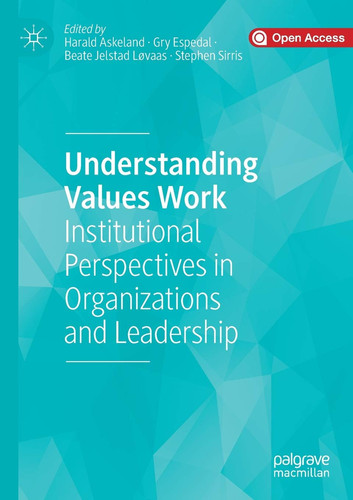
Understanding Values Work Institutional Perspectives in Organizations and Leadership
by Harald Askeland, Gry Espedal, Stephen Sirris, Beate Jelstad Løvaas
- Language
- English
- Published
- 2020
- Publisher
- Springer International Publishing
- Pages
- 296
- ISBN
- 9783030377502
"Understanding Values Work: Institutional Perspectives in Organizations and Leadership" addresses the often-overlooked yet fundamental role of values within organizational settings. While values are central to institutional theories, their practical application and exploration remain understudied. This book responds to a growing interest in how values shape organizational identity, ethos, and the provision of public and civic welfare.
Through a collection of chapters, this work examines the concrete practices of values work as performed by both organizations and their leaders. It integrates institutional perspectives with micro-level approaches, offering a comprehensive view of how values are enacted and sustained. By bridging everyday practices with an organization's core purpose, the book provides insights into how a deliberate focus on values work can enhance organizational practices and improve service quality. This resource is designed for researchers, students, and leaders seeking to understand and implement values-driven leadership in various organizational contexts.
Through a collection of chapters, this work examines the concrete practices of values work as performed by both organizations and their leaders. It integrates institutional perspectives with micro-level approaches, offering a comprehensive view of how values are enacted and sustained. By bridging everyday practices with an organization's core purpose, the book provides insights into how a deliberate focus on values work can enhance organizational practices and improve service quality. This resource is designed for researchers, students, and leaders seeking to understand and implement values-driven leadership in various organizational contexts.
Subjects
Original edition
Understanding Values Work Institutional Perspectives in Organizations and LeadershipOriginally published in 2020 English Springer Nature
Other editions (4)

Listen to the summary Narrated summary
In the intricate tapestry of organizational life, a fundamental thread often remains understated, yet it is woven into the very fabric of identity and purpose: values. These deeply held principles, though central to the definitions of institutions, have long been a subtle force, shaping collective endeavors without always being explicitly examined. Yet, within the dynamic landscape of modern organizations and leadership, a renewed focus emerges, turning attention to the active, ongoing process of "values work."
This endeavor invites us to step into the daily rhythms of organizations, where values are not merely abstract ideals etched in mission statements, but lived performances. It reveals values work as a continuous dance of social and institutional processes, constantly constructing and refining agency, actions, and practices. Here, the essence lies in bridging the grand, aspirational purpose of an organization with the granular, everyday realities of its operations, transforming abstract notions into tangible expressions.
Consider the leader, not as a solitary visionary, but as a steadfast facilitator, constantly tending to the delicate interplay between an organization's mission, its core values, and its evolving character. This is institutional leadership in its purest form, an ongoing commitment to nurturing the "good organization." It involves a continuous dialogue, a reflective process that seeks to define the "good home" where individuals thrive, to champion "the common good" that extends beyond immediate interests, and to forge a shared, embodied understanding of "good practice" that guides every hand and decision.
The journey through values work is not a static one; it is inherently processual, a unfolding narrative where values are both anchors and sails. They possess a curious elasticity, capable of being firmly held yet fluid enough to adapt and evolve with the currents of change. This perspective allows us to observe how values are not simply *discovered*, but actively *brought into being* and reshaped over time through deliberate practices.
Within this dynamic, certain practices emerge as profoundly impactful. Imagine a group of leaders, engaged in deep reflection, openly examining their relational work situations. In these shared spaces, a powerful alchemy occurs: individual actors delve inward, gaining heightened awareness of their own emotions and boundaries, thus constructing a clearer self-identity. From this inward journey, they find the courage to move forward, empowered to implement new actions aligned with their values, ultimately cultivating a relational agency that strengthens organizational practices.
Moreover, the very act of leading in today's complex world often means navigating a confluence of diverse institutional environments, from the subtleties of pluralistic contexts to the vibrant challenges of multicultural workplaces. Here, leaders become skilled navigators, responding to external pressures, transforming established practices, and redefining organizational identities. Their actions, whether forward-looking and projective or deeply ingrained and habitual, are all manifestations of this ceaseless institutional work. They must reconcile conflicting tendencies and facilitate communication, ensuring that core values remain a guiding light amidst the inherent tensions.
Ultimately, embracing and actively engaging in values work offers a profound promise: organizations that diligently attend to these deeply rooted principles are positioned not only to refine their operational practices but also to elevate the very quality of the services they provide. It is through this dedicated cultivation of values that an organization truly flourishes, becoming a more purposeful, cohesive, and impactful entity in the world.
This endeavor invites us to step into the daily rhythms of organizations, where values are not merely abstract ideals etched in mission statements, but lived performances. It reveals values work as a continuous dance of social and institutional processes, constantly constructing and refining agency, actions, and practices. Here, the essence lies in bridging the grand, aspirational purpose of an organization with the granular, everyday realities of its operations, transforming abstract notions into tangible expressions.
Consider the leader, not as a solitary visionary, but as a steadfast facilitator, constantly tending to the delicate interplay between an organization's mission, its core values, and its evolving character. This is institutional leadership in its purest form, an ongoing commitment to nurturing the "good organization." It involves a continuous dialogue, a reflective process that seeks to define the "good home" where individuals thrive, to champion "the common good" that extends beyond immediate interests, and to forge a shared, embodied understanding of "good practice" that guides every hand and decision.
The journey through values work is not a static one; it is inherently processual, a unfolding narrative where values are both anchors and sails. They possess a curious elasticity, capable of being firmly held yet fluid enough to adapt and evolve with the currents of change. This perspective allows us to observe how values are not simply *discovered*, but actively *brought into being* and reshaped over time through deliberate practices.
Within this dynamic, certain practices emerge as profoundly impactful. Imagine a group of leaders, engaged in deep reflection, openly examining their relational work situations. In these shared spaces, a powerful alchemy occurs: individual actors delve inward, gaining heightened awareness of their own emotions and boundaries, thus constructing a clearer self-identity. From this inward journey, they find the courage to move forward, empowered to implement new actions aligned with their values, ultimately cultivating a relational agency that strengthens organizational practices.
Moreover, the very act of leading in today's complex world often means navigating a confluence of diverse institutional environments, from the subtleties of pluralistic contexts to the vibrant challenges of multicultural workplaces. Here, leaders become skilled navigators, responding to external pressures, transforming established practices, and redefining organizational identities. Their actions, whether forward-looking and projective or deeply ingrained and habitual, are all manifestations of this ceaseless institutional work. They must reconcile conflicting tendencies and facilitate communication, ensuring that core values remain a guiding light amidst the inherent tensions.
Ultimately, embracing and actively engaging in values work offers a profound promise: organizations that diligently attend to these deeply rooted principles are positioned not only to refine their operational practices but also to elevate the very quality of the services they provide. It is through this dedicated cultivation of values that an organization truly flourishes, becoming a more purposeful, cohesive, and impactful entity in the world.
No reviews yet. Be the first.