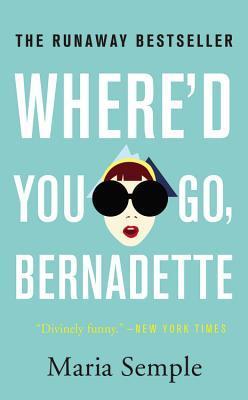
Where'd You Go, Bernadette
by Maria Semple
- First published 2012
- 326 pages
- English
Bernadette Fox is notorious. To her Microsoft-guru husband, she is a fearlessly opinionated partner; to the other mothers at her daughter's elite Seattle school, she is a disgrace; to her brilliant teenage daughter Bee, she is a best friend and, quite simply, mom. A former MacArthur "Genius Grant" recipient for her revolutionary architecture, Bernadette has become a recluse, so allergic to people and Seattle that she relies on a virtual assistant in India to manage her life. But when Bee cashes in a promise of a family trip to Antarctica as a reward for perfect grades, Bernadette's carefully constructed world begins to unravel.
Just as the trip preparations reach a chaotic peak, Bernadette vanishes, leaving behind no clues except a trail of emails, letters, and secret correspondence. It falls to Bee to piece together the puzzle of her mother's disappearance. This inventive and energetic novel reveals a story of misplaced genius and the powerful connection between a mother and daughter, exploring how a woman who has given up her creative life for her family must rediscover herself before she is lost completely.
Just as the trip preparations reach a chaotic peak, Bernadette vanishes, leaving behind no clues except a trail of emails, letters, and secret correspondence. It falls to Bee to piece together the puzzle of her mother's disappearance. This inventive and energetic novel reveals a story of misplaced genius and the powerful connection between a mother and daughter, exploring how a woman who has given up her creative life for her family must rediscover herself before she is lost completely.
What readers say
3.87
612K ratings across the web 7 in 10 readers loved it, 1 didn't like it
The book is widely celebrated for its sharp wit and laugh-out-loud humor, with many reviewers finding it genuinely hilarious and immensely entertaining. Its unique epistolary format, composed of emails, letters, and various documents, is frequently praised as inventive and original, creating an energetic and engaging reading experience. Readers often connected with the vibrant and quirky protagonist, Bernadette, describing her as sassy, witty, and appealingly flawed. Her daughter, Bee, is also highlighted as a lovable and strong-minded character, and their warm, protective mother-daughter relationship resonates with many. The novel's clever social satire, particularly its send-up of Seattle's privileged elites and suburban culture, is appreciated for its insightful observations and comic timing. Despite its comedic tone, some found the story to possess surprising emotional depth, exploring themes of stifled creativity, mental health, and family dynamics in a heartwarming way.
However, the book also drew criticism for several aspects. While Bernadette and Bee were generally liked, many other characters, such as Bernadette's husband Elgin and neighbor Audrey, were often perceived as two-dimensional, unlikeable, selfish, or even caricatures, making it difficult for some readers to connect with them. A common point of contention was the plot's descent into what some reviewers described as overly wacky, absurd, or unrealistic situations, particularly in the latter half, which led to an exhausting or unbelievable narrative for some. The balance between satire and more serious themes, like mental health issues, was also questioned, with some feeling the humor occasionally trivialized the gravity of these topics. Additionally, the ending frequently disappointed readers, who found it rushed, abrupt, unsatisfying, or lacking a clear resolution. For some, the unconventional epistolary style, while innovative, became attention-tiring or disjointed, hindering their immersion in the story.
Overall, this book elicits a strongly mixed reception, proving to be a polarizing read that is either deeply loved or met with significant reservations. Despite its flaws, many reviewers still found it enjoyable and worth reading, appreciating its originality and unique voice. It is likely to appeal most to readers who enjoy smart, witty, and often absurd comedic satire, particularly those who appreciate an unconventional storytelling format composed of various documents. Fans of quirky, eccentric characters and stories that explore complex mother-daughter relationships will also find much to enjoy. However, readers who prefer highly realistic plots, conventional narrative structures, or characters that are consistently relatable and morally unambiguous might find themselves struggling to connect with its unique style and tone, especially if they seek a tidy and fully resolved conclusion.
Reviews
No reviews yet. Be the first.
Details & editions
- This edition
- Little Brown Paperbacks, 2013
- ISBN
- 9780316204262
- Language
- English
Original edition Where'D You Go, Bernadette Originally published in 2012 · English · Back Bay Books
Other editions (90)
- Little Brown and Company · 2012

- Grup Editorial Litera · 2020

- Editura Litera · 2020

- Wahlström & Widstrand · 2013

- Editora Companhia Das Letras · 2013

- Little Brown and Company · 2012

- Little Brown and Company · 2019

- Little Brown and Company · 2014
- Little Brown and Company · 2014

- Blackstone Audio, Inc. · 2012
