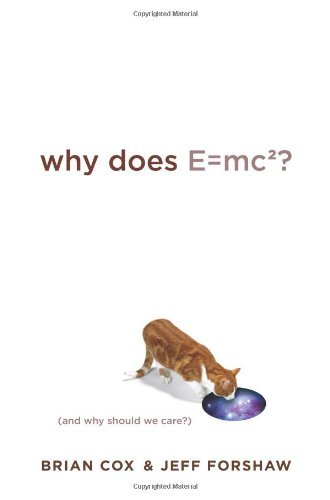
Why Does E=mc2?
- First published 2009
- 265 pages
- English
Unravel the true meaning behind the world's most famous equation, E=mc², an icon often recognized but rarely understood. Brian Cox and Jeff Forshaw guide readers on a journey into the heart of twentieth-first-century physics to unpack Einstein's revolutionary discovery. They clarify the concepts of energy, mass, and light, dismantling common misconceptions and revealing how the very fabric of nature is encapsulated within this succinct formula.
This exploration extends to the cutting edge of scientific experimentation, including a visit to the Large Hadron Collider, where conditions from fractions of a second after the Big Bang are recreated to illuminate the origins of mass. The book demonstrates how E=mc² underpins everything from the life cycle of stars to nuclear power, illustrating that mass and energy are interchangeable forms of the same fundamental entity. By making the theory of relativity accessible, it offers a profound understanding of how the universe operates and why this singular equation has reshaped humanity's view of reality.
What readers say
4.05
11K ratings across the web 8 in 10 readers loved it
Many readers praised the book for its ambitious attempt to demystify complex scientific concepts, particularly the theory behind E=mc². Reviewers frequently highlighted the authors' dedication to making advanced physics accessible, often using high school level mathematics like Pythagoras' theorem to explain intricate ideas. This approach helped many previously intimidated by physics to grasp fundamental principles, fostering a sense of wonder and deeper understanding of the universe. The book was commended for its focus on the underlying science rather than biography, and for articulating the beauty and elegance that physicists find in mathematics and the natural world. Specific topics like the explanation of the speed of light limit and the Higgs field were noted as particularly well-handled and enlightening. The engaging tone and occasional humor were also appreciated, making the challenging journey more enjoyable and inspiring some readers to delve further into the subject.
Despite the authors' efforts at accessibility, a significant number of readers found the book to be challenging and, at times, frustrating. Complaints often centered on the uneven pacing, where the text would oscillate between overly simplistic explanations and dense, difficult material without a smooth transition. Some felt the mathematical explanations, while present, were either too convoluted in prose or skipped crucial steps, leading to confusion even for those with some scientific background. The frequent apologies for including mathematics or the perceived patronizing tone in simplifying concepts were also a point of contention for some. Additionally, several reviewers criticized the overreliance on analogies, which occasionally served to complicate rather than clarify, and noted instances where explanations for examples were delayed or incomplete, making the flow disjointed. For some, the book failed to deliver a complete understanding of its core subject, necessitating multiple re-reads or external research.
Overall, "Why does E=mc²" is a book that evokes mixed reactions, often seen as a challenging but potentially rewarding read. While it successfully brings a clearer understanding of advanced physics to many, its fluctuating difficulty and explanation style mean it may not suit all readers. The book is best suited for non-specialist readers with a strong curiosity about fundamental physics and a willingness to engage with demanding concepts, possibly with a pen and paper in hand. Those who prefer a purely narrative approach without any mathematical engagement, or conversely, hard-core physics enthusiasts seeking rigorous derivations, might find it less satisfying. However, for those prepared to grapple with its complexities, the book offers a chance to appreciate the profound implications of Einstein's theories and the underlying elegance of the cosmos.
Reviews
No reviews yet. Be the first.
Details & editions
- This edition
- Da Capo Press, 2009
- ISBN
- 9780786752164
- Language
- English