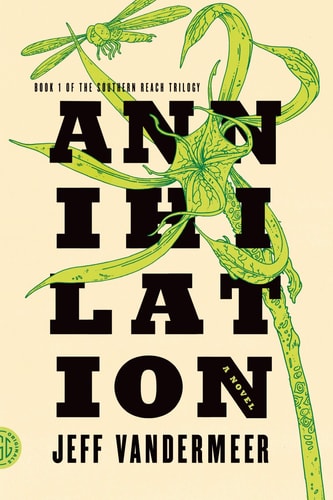
For decades, Area X has been cut off from the rest of civilization, an environmental anomaly that nature has reclaimed. Every expedition sent to explore its pristine but unnatural landscape has ended in disaster. The second mission concluded in mass suicide, the third in a hail of gunfire, and the members of the eleventh returned as empty shells of their former selves, dying of aggressive cancer within weeks. Now, four women embark on the twelfth expedition, their mission to map the terrain and avoid the contamination that has consumed their predecessors.
Led by a psychologist, the team includes an anthropologist, a surveyor, and a biologist who narrates their journey through her field journal. She has her own reasons for entering Area X; her husband was a member of the last doomed expedition. What they discover is a world beyond their comprehension, containing a strange topographic feature not on any map and secrets that begin to turn the team members against one another. In a place where the rules of nature are warped and the very environment seems to be a living entity, the greatest danger might not be what they find, but what they become.
The border shimmered, a barrier of unseen force, and then we were through. We were the twelfth expedition into Area X, a place reclaimed by a nature that defied understanding, an untamed coastal wilderness sealed off from the rest of the world for thirty years. There were four of us: the psychologist, our leader; the anthropologist; the surveyor; and myself, the biologist. A quiet, almost clinical detachment was meant to be our armor, but I carried a deeper, more personal current of unease. My husband had been part of the eleventh expedition, one of the few who had returned, only to die months later, his mind a shattered echo of the man I knew. I sought answers, a ghost in this strange land, hoping to find a trace of what had claimed him.
Almost immediately, the strangeness began. Our sense of time fractured, days blurring into an indistinguishable haze. We discovered a structure, not a tower in the conventional sense, but a winding descent into the earth, its interior walls covered in an intricate, living script of moss that pulsated with an alien message. We called it the Tower, or sometimes, the Tunnel. Down in its depths, the air itself felt different, thick with spores that seemed to seep into our very beings, altering us in subtle, insidious ways.
The psychologist's hypnotic suggestions, meant to keep us calm and compliant, began to unravel. The anthropologist vanished, her last known location near the Tower, leaving only fragmented clues. We later found her, horribly disfigured, her body half-melted, hinting at a gruesome end brought on by something monstrous. It became clear that the previous expeditions had not merely failed; they had been consumed, driven to madness, violence, or transformed into something else entirely.
My own samples, painstakingly collected from the peculiar flora and fauna of Area X, revealed a terrifying truth: they contained human cells. The plants, the strange creatures, even the water, all held fragments of us, a grotesque tapestry woven from the lives that had ventured here. The psychologist, increasingly erratic, eventually leaped from the lighthouse, screaming the word "annihilation" at me, a hypnotic trigger meant to induce my own demise. But something within me resisted, a burgeoning resilience, or perhaps, a change.
I pressed on alone, driven by an instinct that surpassed mere scientific curiosity. At the lighthouse, a beacon in this surreal landscape, I uncovered journals from past expeditions, including my husband's. His words painted a picture of an impossible return, of doppelgängers, and a creeping horror that defied explanation. I learned of the Crawler, the entity that created the moss writing, a being of such alien construction that my mind struggled to process its form.
My body, too, was undergoing a transformation. Wounds healed with uncanny speed, and a subtle "brightness" seemed to emanate from within me. I confronted the Crawler in the depths of the Tower, an encounter that warped my perception and probed the very core of my being. I survived, emerging with more questions than answers, but undeniably changed. The border of Area X, the psychologist had revealed, was expanding.
The world beyond Area X held no appeal for me now. The answers I sought for my husband, for myself, lay within this strange, beautiful, and terrifying wilderness. I knew then that I would not return. I would stay, to understand, to witness, to become whatever Area X intended me to be, forever drawn into its enigmatic embrace.
What other readers say
Liked
Many reviewers praise this book for its profoundly unique vision and original approach to storytelling, describing it as unlike anything else they have read. The author's ability to create a pervasive sense of eerie and unsettling atmosphere is frequently highlighted, with readers reporting a feeling of dread, claustrophobia, and a lingering sense of disturbance long after finishing. The writing style itself receives high acclaim for its poetic, crisp, and intelligent prose, which contributes significantly to the book's distinctive mood. Readers found the narrative captivating and thought-provoking, appreciating how it leaves them breathless and constantly pondering its mysteries.
Disliked
However, a significant number of readers expressed frustration with the book's highly cryptic and ambiguous nature, particularly its inconclusive ending and the deliberate lack of clear explanations for events. This absence of resolution, combined with an unreliable narrator, left some feeling detached from the story and its characters, struggling to connect emotionally. Critics also described the pacing as sluggish, repetitive, or too reflective, leading to a sense of boredom or a feeling that not much 'happens' in terms of conventional plot progression. For these readers, the book's style sometimes overshadowed its substance, resulting in a vacancy of feeling rather than engagement.
In short
Ultimately, this book garners a mixed reception, with many finding it to be a memorable yet challenging read. It is often recommended for fans of 'weird fiction' or speculative fiction who enjoy stories that prioritize mood, atmosphere, and complex ideas over straightforward plot and definitive answers. Readers who appreciate a unique, literary writing style and are comfortable with ambiguity, unreliable narration, and a lingering sense of mystery are most likely to enjoy this experience. Those seeking clear explanations, a fast-paced plot, or strong emotional connections to characters may find themselves less satisfied.