
Add to library
You don't have any lists yet. Create one in My Library.
Go to My LibraryAdd to library
You don't have any lists yet. Create one in My Library.
Go to My LibraryAtonement What Maisie Knew
- Language
- English
- Published in
- Publisher
- Random House
- ISBN
- 9780099511342
Spanning several decades, the narrative follows Briony into adulthood as she grapples with the immense weight of her actions. The story moves from the idyllic pre-war country estate to the chaos of World War II, including the evacuation of Dunkirk, exploring the enduring power of love, the profound nature of guilt, and the complex, lifelong search for forgiveness. It is an examination of the lines between fiction and reality, and whether a storyteller can ever truly repair the damage done by a lie.
Subjects
Original edition details
Other editions (49)
Other editions

Atonement
2003 • Tandem Library
English

Abbitte. 6 CDs.
2003 • Eichborn
German

Atonement Introduction by Claire Messud
2014 • National Geographic Books
English

Atonement (Vintage War) Exp
2014 • Vintage Classics
English

Atonement: Ian McEwan (Everyman's Library CLASSICS)
2014 • Everyman
English

Atonement (signed limited edition)
2007 • Jonathan Cape
English

Atonement A Novel
2003 • Knopf Doubleday Publishing Group
English

Atonement
2005 • Recorded Books
English

Atonement
2002 • Penguin Random House
English

Atonement: A Novel
2002 • Nan A. Talese
English

atonement
2014 • Vintage Books
English

Atonement
2002 • Anchor / Random House
English

Atonement
2011 • Vintage Books
English

Espiazione
2001 • Giulio Einaudi Editore, Torino, Italia
Italian

Atonement
2010 • CCV
English

Atonement
2002 • Recorded Books
English

Atonement
2007 • Vintage
English

Atonement
2002 • Thorndike Pr
English

Atonement
2007 • Anchor
English

Atonement
2001 • Penguin Random House
English

Atonement
2007 • Anchor Books
English

Atonement
2004 • Vintage
English
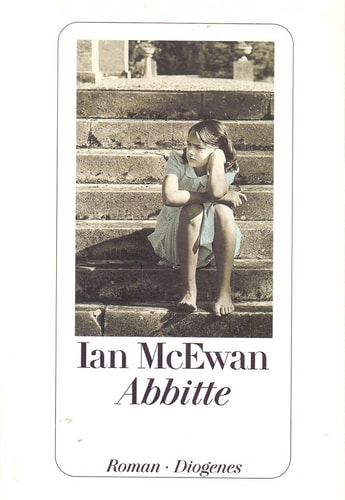
Abbitte.
2002 • Diogenes
German

Atonement
2010 • Vintage Modern Classics
English

Atonement
2006 • Phoenix Audio
English

Atonement
2003 • Anchor Books
English

Atonement
2007 • Vintage Books
English

Atonement
2002 • Thorndike Pr
English

Expiation
2003 • Gallimard
French

Atonement
2012 • Random House of Canada
English

Atonement
2007 • Recorded Books
English

Reparação
2002 • Companhia Das Letras
Portuguese

Atonement
2008 • Vintage Books USA
English

Atonement
2002 • Chivers
English

Atonement
2002 • Vintage
English

贖罪
2009 • 大田出版有限公司
Chinese

Expiación (Spanish Edition)
2002 • Editorial Anagrama
Spanish

Iskuplenie
2021 • Lyuks, AST
Russian

Atonement
2002 • Chivers Audio Books
English

Atonement
2002 • Penguin Random House
English

Atonement
2005 • Vintage
English

Reviens-moi
2005 • Gallimard
French

Atonement
2001 • Penguin Random House
English

Atonement
2011 • Penguin Random House
English

Atonement
2007 • Seal Books
English

Atonement
2007 • Vintage Canada
English

Atonement Discover the modern classic that has sold over two million copies.
2010 • Random House
English

Atonement
2010 • Penguin Random House
English

Atonement
2007 • Anchor
English
From the nursery window, she witnesses a scene by the fountain that she cannot parse. Her older sister, Cecilia, home from Cambridge and adrift in languid boredom, stands with Robbie Turner, the clever, handsome son of their charlady. There is an argument, a moment of tension over an antique vase, and then the shocking, inexplicable sight of Cecilia stripping to her underwear and plunging into the fountain's basin to retrieve broken pieces of porcelain. To Briony, watching from above, it is a tableau of ugly threat and mysterious subjugation. What strange power does he have over her? The scene feels charged with a significance she cannot grasp, a secret rite from which she is excluded. It is her first intimation that the world is not a story she can control, and that it is terrifyingly easy to get everything wrong.
Her nascent suspicions are set ablaze later that afternoon. Tasked with delivering a note from Robbie to Cecilia, Briony's simmering jealousy and writerly curiosity compel her to open it. The note contains a clinical, obscene word that strikes her with the force of a physical blow. It is a revelation of a depraved mind, a confirmation of the darkness she sensed at the fountain. The word becomes a key, unlocking a narrative of lurking evil. Later, searching for her sister, she pushes open the library door and finds them in the half-light, locked in a desperate embrace against the shelves. To her eyes, it is not passion but a struggle; Cecilia's terrified eyes meet hers over Robbie's shoulder. He is an attacker, a maniac. The evidence is irrefutable. Her story now has a hero and a villain, and she, Briony, is its central witness.
That night, as the family gathers for a tense dinner, the twin boys run away. During the search, in the humid darkness of the grounds, Briony wanders toward the island temple by the lake. There, she discovers a scene of true violation. She sees a figure assaulting her cousin Lola before melting back into the shadows. When the figure is gone, Lola is a whimpering shape on the ground. Briony's narrative snaps shut. The disparate, confusing events of the day now form a perfect, horrible symmetry. “I saw him,” she whispers to her cousin, her certainty a beacon in the disorienting dark. “It was him, wasn't it?” In Lola's dazed silence, Briony finds all the confirmation she needs. It was Robbie. Her testimony is unwavering, a child's clear-eyed conviction in the face of adult hesitation. Before the sun rises, Robbie Turner is led away in handcuffs, his mother's cries of “Liars!” echoing across the misty park, unheard or unheeded by the girl who has just sealed his fate.
Years pass. It is 1940, and Corporal Robbie Turner is in France, retreating with the routed British army toward Dunkirk. The world has descended into a chaos that mirrors the ruin of his own life. He is haunted by images of the war's casual brutality - a child's leg wedged in the fork of a tree - and by the memories of a prison sentence he did not deserve. He survives on a single, animating hope: Cecilia. Her letters are his lifeline, her promise his reason to live. “I'll wait for you. Come back,” she writes, and the words are a talisman against the encroaching madness. He carries her last letter, which contains the astonishing news that Briony, now a young woman, wishes to recant her testimony. The possibility of his name being cleared, of a life with Cecilia being restored, is a fragile dream he clings to as he stumbles through the carnage-strewn fields, his only purpose to reach the sea.
In London, Briony's atonement has taken the form of a nurse's uniform. She has renounced Cambridge and a writer's life for the punishing routines of hospital work, a penance of sluice rooms, carbolic soap, and the unthinking obedience demanded by Sister Drummond. The war she has sought finds her when the first wave of wounded from Dunkirk floods the wards. The hospital becomes a charnel house of shattered bodies and unspeakable suffering. In the midst of the horror, tending to the dying, she is stripped of her childish arrogance. When she is sent to comfort a young French soldier with a catastrophic head wound, she holds his hand and enters his dying delirium, pretending to be the girl from his village he mistakes her for. “It's Briony,” she whispers to him as he dies, an assertion of self in an act of selfless compassion. She is beginning to understand the true nature of the damage she has done.
One Saturday in 1940, Briony finally stands before her sister in a small, cheerless flat in Balham. Cecilia is a ward sister, her face hardened by sorrow and resentment. And then Robbie appears, alive, home from Dunkirk on a brief leave. The confrontation is brutal. Robbie's fury is a cold, quiet thing, the anger of a man whose life has been stolen. “I'm torn between breaking your stupid neck here and taking you outside and throwing you down the stairs,” he tells her. Briony stands before them and accepts her guilt. She agrees to their terms: she will go to her parents and tell them the truth; she will write a sworn statement retracting her evidence. Before she leaves, she reveals one last, crucial piece of the puzzle: the man who attacked Lola was the chocolate millionaire, Paul Marshall, whom Lola has since married. The meeting ends not with forgiveness, but with a set of instructions. “Just do all the things we've asked,” Robbie tells her. It is a fragile, conditional peace, but as she descends into the tube station, leaving the lovers to their stolen hour, Briony feels a sense of release. She has a path forward. The attempt to atone has begun.
But there was no reunion in Balham. Today is my seventy-seventh birthday, and I am dying. My mind, a doctor has told me, is closing down. The truth is, I never saw my sister again after her visit to my nursing hostel. And Robbie Turner died of septicemia at Bray Dunes on the first of June, 1940. He never saw Cecilia again, either. She was killed four months later, drowned in the flooded Underground station at Balham during an air raid.
How can a novelist achieve atonement when, with her absolute power of deciding outcomes, she is also God? There is no one, no entity or higher form that she can appeal to, or be reconciled with, or that can forgive her. There is nothing outside her. In her imagination she has set the limits and the terms. The attempt was all. My fifty-nine-year assignment is over. I could not bear to end my story with the bleakness of the truth. So in my final draft, I gave them their life together. I gave them their happiness, but I was not so self-serving as to let them forgive me. It was a final act of kindness, a stand against oblivion, to let my lovers live and to unite them at the end. As long as there is a single copy, a solitary typescript of my final draft, then my spontaneous, fortuitous sister and her medical prince survive to love.
No discussions yet for this book.
Delete Discussion
Are you sure you want to delete this discussion? This action cannot be undone.
Rating Sources
Reviewers widely commend the book for its exquisite and masterful prose, often describing it as beautiful, lush, and precise, with a command of language that transports the reader to its settings. Many highlight the author's exceptional talent for crafting vivid descriptions and offering deep psychological insight into the characters' minds, particularly the protagonist's complex inner world. The character development is frequently praised for its realism and depth, making even challenging personalities believable. The novel's innovative narrative structure and experimental approach to storytelling are also noted as strengths, offering a fresh and engaging experience. Furthermore, readers found the exploration of profound themes such as moral dilemmas, guilt, memory, and the nature of fiction to be compelling and thought-provoking, often leading to a powerful emotional impact that resonates long after finishing the book.
Despite widespread acclaim, some readers expressed reservations, particularly regarding the book's pacing. The initial sections are occasionally described as slow, ponderous, or even boring, with some feeling that the story takes too long to develop. A number of reviewers found certain characters to be lacking in personality or difficult to connect with, while others struggled with the credibility of key plot points. Some of the innovative narrative techniques, especially the post-modernist elements, were viewed by a segment of readers as either a "trick" or gimmicky, undermining the suspension of disbelief. Additionally, some felt the inclusion of detailed wartime scenes felt disjointed or underdeveloped, and a few questioned the narrative's focus, suggesting it disproportionately emphasized one character's actions while appearing to sideline other significant events or characters.
Overall, the book is widely considered a powerful, complex, and thought-provoking work, frequently lauded as a modern masterpiece that leaves a lasting impression. It is recommended for readers who appreciate literary fiction, intricate character studies, and a rich, evocative writing style. Those who are patient with a slower narrative build-up and open to experimental storytelling, including meta-narrative elements that challenge the boundaries of fiction and reality, are likely to find it highly rewarding. The novel will appeal to individuals interested in deeply emotional stories that delve into themes of guilt, memory, and the profound consequences of youthful actions, even if the ending leaves them with a sense of melancholy or an unresolved feeling.
No reviews yet. Be the first to review this book!
Delete Review
Are you sure you want to delete this review? This action cannot be undone.


