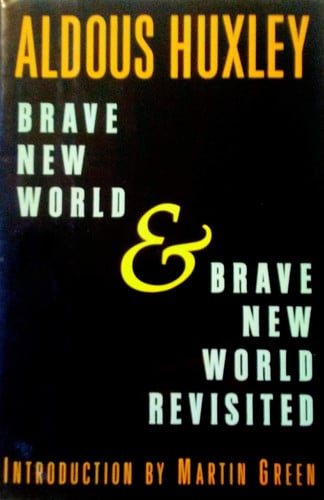
In the year of stability, A.F. 632, life begins not with a cry, but with the quiet hum of machinery in the Central London Hatchery and Conditioning Centre. Here, in a world built on the principles of Community, Identity, and Stability, humanity is decanted from bottles, its destiny predetermined from the test tube. Alphas, Betas, Gammas, Deltas, Epsilons - each caste is chemically and psychologically engineered for its role. From the moment of their creation, they are conditioned through sleep-teaching, or hypnopaedia, their minds inscribed with the State's wisdom until it becomes their own. “A gramme is better than a damn,” the whispers teach. “Ending is better than mending.” “Everyone belongs to everyone else.”
Among the Alphas, who wear grey and bear the burden of thought, there are those who feel a dissonance in the perfect harmony. Bernard Marx is one such man, smaller than he should be, an outsider haunted by a rumored drop of alcohol in his blood-surrogate. He feels a loneliness that has no name in this world of compulsory happiness. His friend, Helmholtz Watson, is an outsider for the opposite reason: he is too capable, a writer of propaganda who feels a yearning to write about something more, something he cannot name. Bernard's desires fixate on Lenina Crowne, a perfectly pneumatic Beta who is as conventional as she is beautiful, yet who agrees, with some trepidation, to accompany him on a trip to a Savage Reservation in New Mexico.
The Reservation is a shock, a preserved relic of the old world. Here, dirt is a reality, not a historical concept. People grow old, wrinkled, and sick. They are born from mothers, a word so obscene it is spoken only in whispers. They worship strange gods and suffer pain without the blissful relief of soma. For Lenina, it is a waking nightmare of filth and decay. For Bernard, it is a vindication of his own feelings of otherness. It is here they meet Linda, a woman lost from the civilized world decades ago, now bloated and aged, and her son, John - a young man raised on the stories of a “brave new world” and the tattered pages of William Shakespeare. When Bernard learns that John's father is none other than the Director of Hatcheries himself, he sees an opportunity and brings them both back to London.
John, now known as “the Savage,” becomes an instant celebrity, and Bernard, his keeper, is swept up in a wave of unearned popularity. But John's wonder at the gleaming new world quickly sours into horror. He is disgusted by the identical Bokanovsky twins, repulsed by the mindless pleasure of the “feelies,” and horrified by a society that has traded truth and beauty for placid contentment. His Shakespearean ideals of love and honor clash violently with the casual promiscuity of this world, especially in his agonizing, unconsummated passion for Lenina. He sees her as a figure of divine purity, while she sees him as a desirable man who inexplicably refuses to “have” her. “O brave new world,” he murmurs, the words curdling from wonder into the bitterest irony.
Linda, meanwhile, finds her only solace at the bottom of a soma bottle, embarking on a permanent holiday from a reality she can no longer endure. Her inevitable death in the Park Lane Hospital for the Dying becomes the catalyst for John's rebellion. He is tormented not only by his grief - a scandalous and obscene emotion in this society - but by the arrival of a group of identical Delta twins, brought in for their “death conditioning,” who stare at his dying mother with the morbid, unfeeling curiosity of children poking at a strange insect. Their presence defiles the sanctity of his sorrow, and a storm of rage breaks within him.
Fleeing the hospital, John intercepts the Deltas' daily soma distribution, a ritual he now sees as the distribution of poison and chains. “I come to bring you freedom!” he cries, throwing the tablets away. The ensuing riot is a chaotic clash of his violent ideals and their conditioned horror of deprivation. Helmholtz Watson, seeing a spark of the meaningful struggle he has craved, joyfully joins the fray. Bernard, however, vacillates in terror, torn between loyalty and self-preservation. The rebellion is quickly quelled by the police, who subdue the crowd with soma vapor and the soothing, synthetic voice of reason.
Brought before Mustapha Mond, the Resident World Controller for Western Europe, John and Helmholtz engage in a final, profound debate over the nature of civilization. Mond, a man who himself once skirted the edge of heresy, explains the logic of their world with a disarming frankness. Society has chosen happiness and stability over art, science, and God. High art creates social instability; unrestricted truth is a menace. Suffering, passion, and spiritual longing have been engineered out of existence, replaced by pleasant vices and the universal balm of soma. “Christianity without tears - that's what soma is,” the Controller explains. When John insists on the value of struggle and pain, Mond calmly offers him a choice. “You're claiming the right to be unhappy,” he says. “Not to mention the right to grow old and ugly and impotent…the right to be tortured by unspeakable pains of every kind.”
“I claim them all,” the Savage declares.
Fleeing to a deserted lighthouse, John attempts to purge himself of the filth of civilization through self-flagellation and ascetic ritual. But the world will not let him be. His violent penance is captured by a feely-photographer and becomes a sensational film. Helicopters descend, and curious crowds gather to watch him, demanding he perform his whipping stunt. When Lenina arrives, her presence pushes him over the edge. In a frenzy of desire and self-loathing, he attacks her with the whip, a horrific spectacle that the crowd mimics, turning his private agony into a communal, rhythmic orgy. The next morning, when the curious return, they find his body hanging from an archway. Slowly, very slowly, like two unhurried compass needles, his feet turn towards the right, then back towards the left, a final, silent testament to a world that had no place for him.