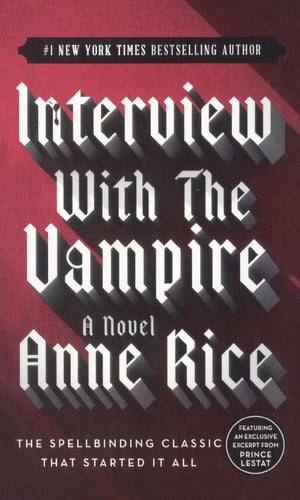
In a darkened room, a vampire named Louis de Pointe du Lac tells the story of his 200-year life to a reporter. It begins in 1791 New Orleans, where Louis, a wealthy plantation owner wracked with grief over his brother's death, encounters Lestat de Lioncourt. Alluring and terrifying, Lestat offers him an escape from his mortal suffering through the gift of immortality. Louis accepts, only to find that eternal life is a curse of moral decay and relentless thirst, forcing him to confront the nature of good and evil as he struggles to hold on to his humanity.
Their volatile companionship spans decades, from the Louisiana plantations to the streets of New Orleans and beyond. The dynamic is further complicated by the creation of Claudia, a five-year-old girl turned into a vampire, forever trapping a woman's mind in a child's body. This gothic horror novel explores the depths of love, loss, loneliness, and desire through the eyes of a reluctant predator. It is a journey into the meaning of existence when time has no end, questioning whether immortality is a gift or an unbearable sentence.
The flickering gaslight cast long, dancing shadows across the room as Louis de Pointe du Lac, a creature of the night for two centuries, began to unravel the tapestry of his immortal life for the eager young reporter. His voice, a low murmur, carried the weight of ages, telling of a bygone era in 1791 Louisiana, where he, a grief-stricken plantation owner, courted death after the loss of his brother. It was then, amidst his despair, that the charismatic and flamboyant Lestat de Lioncourt appeared, offering not solace, but an escape from mortality itself. The embrace was agonizing, a fiery transformation that left Louis forever changed, a vampire struggling with a conscience, forever burdened by the act of taking human life.
Initially, Louis found himself both repulsed by and drawn to Lestat, his maker. Lestat reveled in his new existence, embracing the predatory nature of vampirism with a chilling delight, while Louis grappled with profound moral conflict, clinging to the remnants of his humanity. He fed on animals, despising the thought of preying on humans, a stark contrast to Lestat's more cavalier approach. Their tumultuous existence in New Orleans, amidst the opulent decay of the French Quarter, was one of uneasy companionship, marked by Lestat's cruel lessons and Louis's persistent melancholy.
Their fragile bond took a dramatic and unsettling turn with the introduction of Claudia, a child of five, found amidst the plague-ridden streets. Lestat, in a moment of perverse manipulation, transformed her into a vampire, forever trapping her mature, cunning mind within the body of a doll. Claudia quickly adapted to her new nature, far more readily than Louis, becoming a creature of chilling efficiency and a fierce, possessive love for her "father" Louis. Yet, as decades passed, her eternal childhood became a torment, a gilded cage for her burgeoning intellect and desires. The frustration festered, culminating in a desperate, vengeful plot to rid themselves of Lestat, a scheme born of Claudia's profound dissatisfaction with her unending, unchanging form.
After their daring, though ultimately unsuccessful, attempt to destroy Lestat, Louis and Claudia fled across the ocean, seeking others of their kind, hoping to find answers to the mysteries of their existence. Their journey led them to Paris, a city teeming with life and, to their astonishment, a hidden coven of vampires residing within the Théâtre des Vampires. These were not the solitary, tormented beings Louis had known, but a theatrical troupe who feigned human mortality, performing gruesome charades for unsuspecting audiences, blurring the lines between art and horrific reality.
Among them was Armand, an ancient and enigmatic vampire, whose weary wisdom and profound understanding of their kind captivated Louis. A deep, intellectual connection began to form between them, promising a different kind of companionship, a respite from the loneliness Louis had carried for so long. However, their nascent bond was brutally severed when the Parisian coven, led by the cunning Santiago, discovered Claudia's transgression against Lestat. As punishment for attempting to kill her maker, Claudia was condemned to the sun, a horrific, fiery end that Louis was powerless to prevent.
The loss of Claudia shattered Louis, stripping away the last vestiges of his human-like morality. Consumed by a cold, searing rage, he unleashed a devastating vengeance upon the Théâtre des Vampires, burning their sanctuary and annihilating those who had taken Claudia from him. He found himself drawn into Armand's world for a time, but the ancient vampire could not fill the void left by Claudia, nor could he quell Louis's profound sense of disillusionment with immortality. The centuries that followed were marked by wandering, by an endless search for meaning in a life without end, a journey fraught with existential questions and the gnawing tedium of eternity. As the interview drew to a close, Louis offered the young reporter a taste of his own power, a desperate, weary attempt to convey the crushing burden of his existence, but the boy, mesmerized by the allure of eternal life, saw only the glamour, the power, and missed the profound, unending sorrow.
What other readers say
Liked
Reviewers widely praise Interview with the Vampire for its dark, gothic, and sensual atmosphere, often describing it as haunting and macabre. Many highlight Anne Rice's beautiful, lyrical, and baroque prose, as well as her vivid descriptive imagery, which immerses readers in the settings of 18th-century Louisiana and Old World Europe. The novel is widely recognized for its groundbreaking influence on vampire literature, popularizing the concept of empathetic, complex, and psychologically deep vampires who grapple with their immortality, loneliness, and the eternal struggle between good and evil. Readers appreciate the intricate character dynamics, particularly the compelling portrayals of the central figures, whose relationships explore universal human emotions like love, hate, guilt, and the search for meaning. The book's philosophical depth, its examination of morality, and its unique take on vampiric existence are frequently cited as its strongest aspects, offering a narrative that transcends typical genre conventions.
Disliked
Despite its strengths, several reviewers found the book to be slow-paced, monotonous, and overly repetitive, particularly regarding the protagonist Louis's constant philosophical musings and existential angst, which some described as "whining." The writing style, while praised by some, was criticized by others for being "purple prose" or excessively detailed to the point of boredom. A significant concern raised by multiple readers is the problematic depiction of the relationship between Louis and the child vampire, Claudia, with descriptions of their interactions being labeled as "creepy" and having an "air of pedophilia." Additionally, Louis's background as a plantation owner in 18th-century Louisiana, coupled with his perceived racism, made it difficult for some to sympathize with him. Some readers felt the plot lacked excitement or clear direction, leading to a sense of disappointment, and a few preferred the movie adaptation, finding the book less engaging.
In short
Ultimately, Interview with the Vampire is considered a landmark work in vampire literature, highly impactful for its innovative portrayal of vampires as complex, empathetic, and morally ambiguous figures. While its slow pace, extensive philosophical introspection, and certain problematic elements may not appeal to all, it offers a deeply atmospheric and psychologically rich experience for those seeking more than just a surface-level horror story. This book is particularly recommended for readers who appreciate gothic horror, philosophical fiction, and character-driven narratives that delve into themes of immortality, loneliness, grief, and the human condition. It will resonate with those looking for a dark, sensual, and emotionally profound exploration of vampirism, especially if they are open to its unique narrative style and challenging subject matter, and are interested in the genre's historical evolution.
![Cover of [ Edition 2] Interview with the Vampire ( hard Hardcover ) inside a clean [ free shipping ](Chinese Edition)](https://images.isbndb.com/covers/5447923484967.jpg)