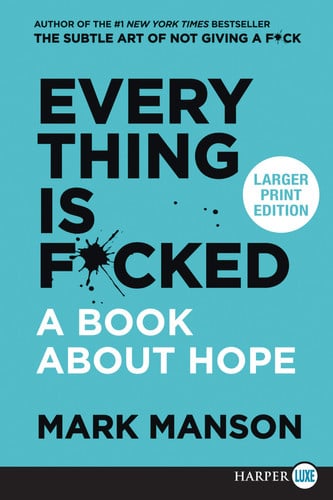
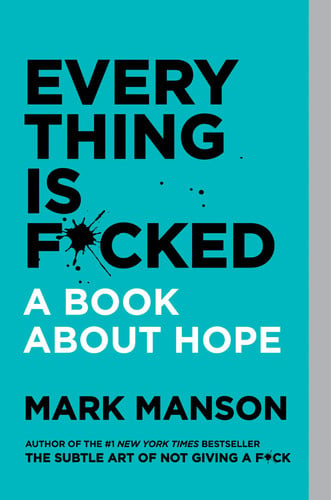
Positives The reviews for this book highlight several positive aspects that resonated with many readers. Reviewers frequently praised the author's ability to tackle complex philosophical and psychological concepts, such as those drawn from Nietzsche, Kant, and Stoicism, and present them in an accessible, often witty, and easy-to-understand manner. Many found the book to be well-researched, insightful, and thought-provoking, prompting deep reflection and challenging their existing beliefs. Some appreciated its more mature and deeper tone compared to the author's previous work, seeing it as a brave attempt to explore significant themes like hope, meaning, and personal responsibility, ultimately helping them make sense of their minds and the contemporary world.
Negatives However, the book also drew significant criticism, leading to highly polarized opinions. A common complaint was the book's perceived lack of coherence, with many describing it as a jumbled collection of essays or articles rather than a unified narrative. Reviewers often found the writing style inconsistent, oscillating between academic and overly casual, with slang and vulgarity that felt forced or intended for shock value. Numerous critics argued that the author oversimplified complex philosophical ideas, misunderstood certain concepts, or merely rehashed material from other well-known thinkers without adding sufficient original insight. The tone was frequently described as condescending, patronizing, or out of touch, with some reviewers finding the generalizations, particularly concerning mental health, to be preposterous. Additionally, the book was sometimes deemed dry, uninspiring, repetitive, and boring, with certain chapters or historical examples feeling dragged out or disconnected.
Conclusion Ultimately, this book generates strong, often conflicting, reactions from its readership. It is most likely to appeal to readers who enjoyed the author's previous works and are prepared for a more philosophical, confrontational, and less overtly "hopeful" exploration of life's inherent difficulties. Those who appreciate a direct, often provocative style, are open to having their biases questioned, and are willing to engage with complex ideas presented unconventionally may find significant value and a challenging reading experience. Conversely, readers seeking a traditional self-help guide, a linear and consistently structured narrative, nuanced philosophical discussion, or a uniformly uplifting message might find the book disappointing, confusing, or even offensive.