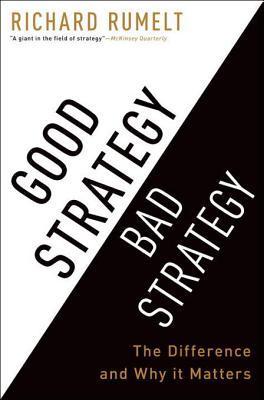
Good Strategy Bad Strategy: The Difference and Why It Matters

Richard P. Rumelt

  • First published 2010
  • 323 pages
  • English
Many organizations struggle with strategy, often mistaking lofty goals or vague visions for a coherent plan of action. Richard Rumelt's Good Strategy Bad Strategy dissects this common confusion, revealing why so much of what passes for strategy is ineffective and how to build a truly impactful approach. He argues that good strategy is not merely ambition or a list of desires; it is a focused response to a critical challenge, built upon a clear diagnosis of the problem, a guiding policy to address it, and a set of coherent actions designed to overcome obstacles.

This book provides a framework for distinguishing genuine strategy from the "fluff" and empty objectives that often derail initiatives. It demonstrates how effective strategy requires honest assessment, difficult choices, and the disciplined coordination of resources and efforts. By understanding the fundamental difference between good and bad strategy, readers gain the tools to analyze situations, make informed decisions, and develop plans that lead to tangible results.
4.12
19K ratings across the web
8 in 10 readers loved it
Reviewers widely praise this book for its exceptional clarity and insightful approach to strategy. Many highlight its strength in demystifying a complex subject, cutting through common corporate fluff, jargon, and empty slogans to define what true strategy entails. The book is commended for presenting a simple yet powerful mental model, often referred to as the "kernel" of strategy, which focuses on diagnosis, guiding policy, and coherent action. Readers appreciate the numerous real-world examples and case studies drawn from diverse fields, including business, non-profits, government, and even military history, which help illustrate its core principles effectively. The book is frequently recommended as a fundamental and indispensable resource that helps readers rethink their approach to strategic challenges.

Despite its strengths, several reviewers found the book to be overly long and repetitive, suggesting its core ideas could have been condensed into a much shorter format. Some parts, particularly later sections, were criticized for feeling disconnected from the main thesis or for delving into irrelevant topics. A recurring point of contention is the author's tone, which some describe as arrogant, surly, or haughty, with instances of selective hindsight making past strategies appear infallible. Critics also note that while the book excels at identifying bad strategy, it offers less practical guidance on how to implement good strategy or explore the cultural reasons behind the proliferation of poor strategic thinking. Some felt the detailed examples, while numerous, occasionally dragged on or served more as personal anecdotes than actionable lessons.

Ultimately, the book is considered a highly valuable and often definitive guide to understanding strategy, despite its perceived length and the author's tone. It effectively distinguishes between genuine strategy and mere goal-setting or aspirational statements, providing a robust framework for analytical thinking. This book is particularly well-suited for leaders, executives, managers, and students across various disciplines who seek to develop a clearer, more rigorous approach to problem-solving and decision-making. It is recommended for anyone looking to cut through corporate buzzwords and grasp the fundamental components of effective strategy, especially those willing to engage deeply with conceptual insights rather than seeking a simple, templated solution.

No reviews yet. Be the first.

Investing in people
Cover of Investing in people
Free

Investing in people

International Finance Corporation. Environment Division