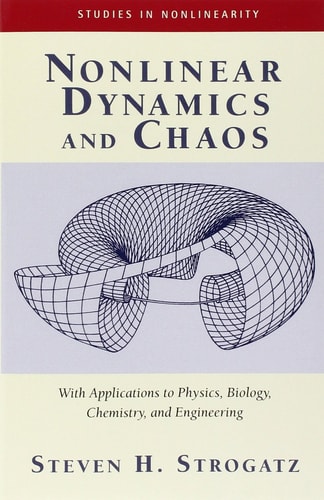
Step into a world where the simplest equations can give rise to breathtaking complexity, where predictable rhythms can suddenly dissolve into erratic dance, and where seemingly random events are governed by an underlying, deterministic order. This journey begins with the fundamental building blocks of change: first-order differential equations. You'll learn to trace the paths of systems evolving through time, understanding how their states shift and settle, or perhaps resist settling altogether. The concept of bifurcations emerges as a crucial turning point, revealing how a subtle tweak in a system's parameters can lead to a dramatic, qualitative alteration in its behavior, much like a river suddenly changing its course.
From these foundational insights, the exploration expands into the phase plane, a powerful landscape where the interplay of two variables paints a complete picture of a system's dynamics. Here, you'll encounter the graceful orbits of limit cycles, representing stable, repeating patterns found in everything from the beating of a heart to the oscillations of chemical reactions. Yet, even these stable rhythms can undergo their own bifurcations, leading to the birth or death of cycles, or even more intricate dance patterns. The analytical methods employed here are always grounded in concrete examples and illuminated by geometric intuition, making the abstract feel tangible.
The journey then propels you into the heart of chaos itself, where the renowned Lorenz equations stand as a monument to sensitive dependence on initial conditions - the famous butterfly effect. A tiny, imperceptible difference in starting conditions can lead to vastly different outcomes over time, making long-term prediction impossible despite the system being entirely deterministic. You'll witness how these equations, born from attempts to model atmospheric convection, unveil a "strange attractor," a fractal-like region in phase space where chaotic trajectories are confined, never repeating but always staying within certain bounds.
This exploration of chaos extends to iterated maps, discrete dynamical systems that capture the essence of nonlinear behavior in a simpler form. Here, the mesmerizing phenomenon of period doubling unfolds, a cascade of bifurcations where a stable cycle repeatedly doubles its period, eventually leading to the onset of chaos. Concepts like renormalization and fractals naturally arise in this context, revealing self-similar patterns at every scale, from the intricate branching of coastlines to the complex structures within strange attractors.
The profound implications of these nonlinear principles are then vividly demonstrated across a spectrum of disciplines. In physics, you'll see them at play in mechanical vibrations and the intricate dynamics of lasers. Biology reveals their hand in the rhythmic firing of neurons, the synchronized flashing of fireflies, and the complex oscillations of biological rhythms, even extending to models of insect outbreaks and the spread of epidemics like the SIR model.
Chemistry offers examples in the form of oscillating reactions and complex chemical oscillators, while engineering benefits from understanding how these dynamics impact superconducting circuits and even how chaos can be harnessed for secure communication. The elegance of the Kuramoto model, for instance, provides a window into the self-organization of large populations of coupled oscillators, offering insights into synchronization phenomena in diverse complex systems and networks, from brain activity to social trends.
Through it all, the emphasis remains on connecting these deep theoretical insights to the tangible world, showing how the seemingly abstract mathematics of nonlinear dynamics and chaos provides a powerful lens through which to understand and even predict the rich, often surprising, behavior of systems all around us. The aim is to build a strong foundation, fostering both analytical skills and an intuitive grasp of the wonders of the nonlinear world.