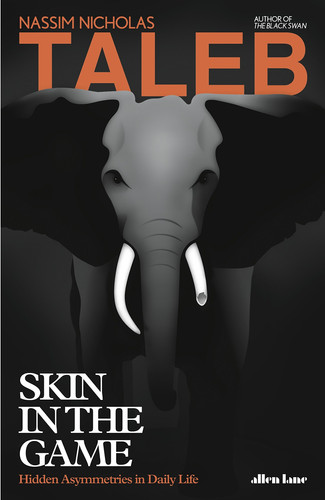
The very fabric of existence, from the grand machinations of empires to the smallest personal decisions, is governed by a singular, unyielding principle: the bearing of consequences. This is the essence of having skin in the game - a fundamental symmetry where those who reap rewards must also face the downside, where risks are shared, and accountability is not a mere suggestion but an inescapable reality. Without this vital component, systems become fragile, ethics dissolve, and understanding falters.
Consider the pervasive asymmetries that plague our modern world. Too often, a class of decision-makers, be they financial executives, policy advisors, or self-proclaimed experts, can profit handsomely from their actions while insulating themselves from any corresponding losses. They engage in what might be called "cheap talk," offering opinions and implementing strategies without ever putting their own neck on the line. This distortion, where one party benefits from the upside while transferring the downside to others, is not merely an incentive problem; it is a profound ethical failing that corrupts justice and undermines efficiency.
True knowledge, it becomes clear, is forged not in the sterile halls of academia or through complex predictive models, but through direct exposure to the world's unforgiving realities. Theoretical understanding, devoid of practical consequence, is often a dangerous illusion. It is only when one has something tangible to lose - reputation, wealth, or even life itself - that genuine learning occurs, a process the ancients called *pathemata mathemata*, or learning through pain. The systems that survive and thrive are those that continuously shed their weakest links, eliminating the foolish and the reckless through the harsh but effective mechanism of skin in the game.
The bedrock of ethical behavior lies in this very symmetry. The Golden Rule, "Do unto others as you would have them do unto you," is often impractical, for how can one truly know what is "good" for another? A more robust and universally applicable principle emerges: the Silver Rule, "Do not treat others the way you would not like them to treat you." This negative formulation accounts for the inherent uncertainty of outcomes and places the emphasis on avoiding harm, ensuring that if your actions inflict suffering, you too must bear a portion of that burden.
This principle extends to the very structure of society. Freedom, often lauded as an abstract ideal, is in practice inextricable from the willingness to shoulder one's own risks. Those who seek to control the lives of others, or to impose their will without personal cost, are often the very "Intellectuals Yet Idiots" who remain blind to the cascading, unpredictable consequences of their grand designs. They are the ones who, from a safe distance, prescribe interventions that unravel complex, time-tested arrangements, never having to face the ruin their theories can bring.
Even small, intolerant minorities can exert immense influence and drive widespread change, provided they possess skin in the game. Their unwavering commitment, backed by a willingness to suffer for their beliefs, can force an entire population to adapt, simply because the cost of resisting their demands becomes too high. This "minority rule" demonstrates that conviction, when coupled with personal exposure to risk, is a potent force that shapes cultures and societies far more than the casual preferences of the majority.
Ultimately, this is a call to recognize the profound wisdom embedded in ancient codes, in the very logic of survival, and in the humility that comes from confronting uncertainty with personal stakes. It demands that we scrutinize not what people say, but what they do, and how much they are willing to risk for their convictions. For it is only when rewards and risks are inextricably linked that we can hope for true fairness, robust systems, and a genuine understanding of a world that consistently defies our attempts to tame its inherent randomness.


![Skin in the Game [Paperback] [Feb 26, 2018] Taleb, Nassim Nicholas](https://images.isbndb.com/covers/24805903482273.jpg)