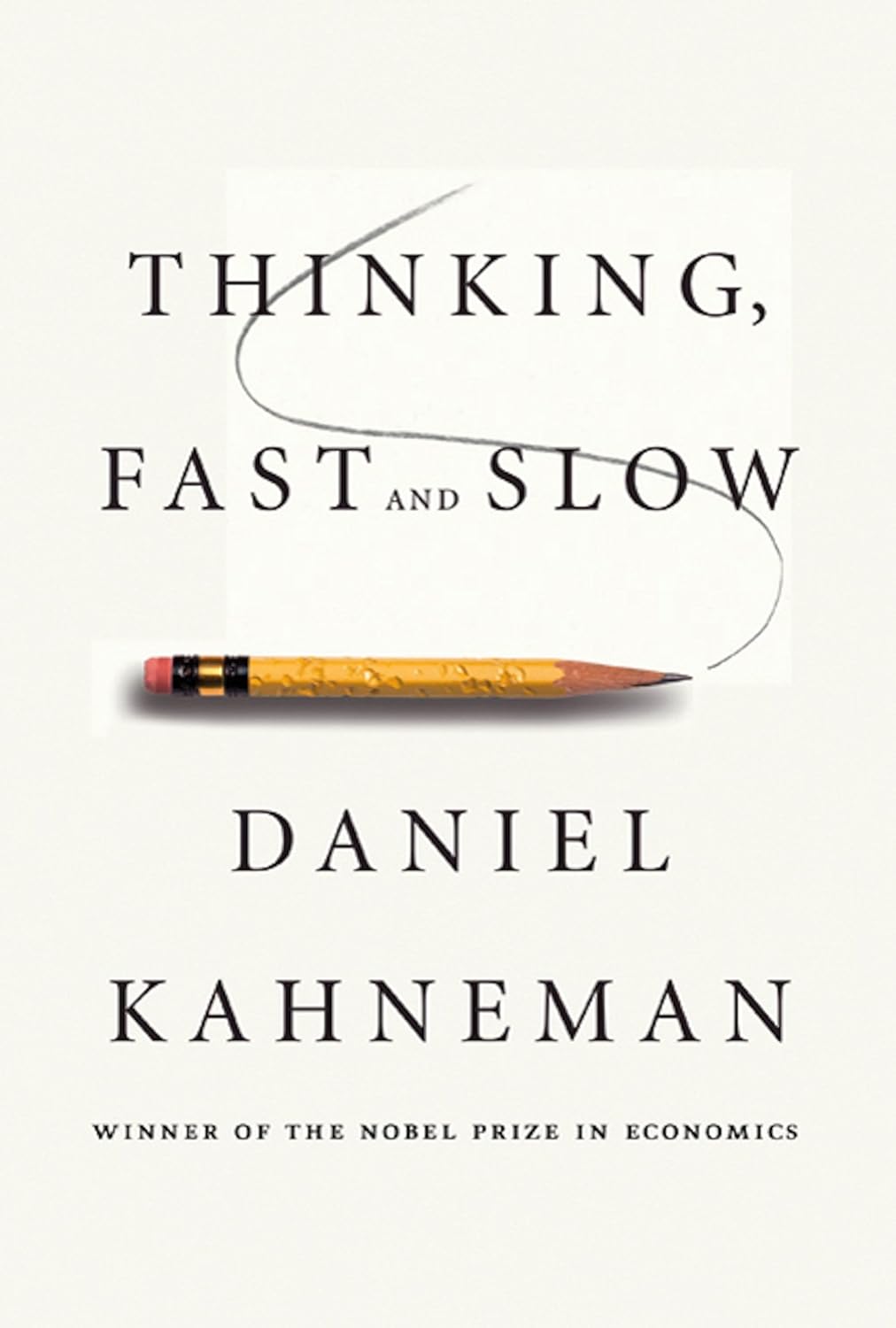
In an exploration of the mind, Nobel laureate Daniel Kahneman introduces the two systems that shape human judgment and choice. System 1 is fast, intuitive, and emotional; it operates automatically and is the secret author of many of our thoughts and impressions. System 2 is slower, more deliberate, and logical; it is the conscious self we identify with, the one that engages in effortful mental activities. This book takes the reader on a tour of how these two systems function, exposing the extraordinary capabilities, as well as the faults and biases, of intuitive thinking and revealing the pervasive influence of first impressions on our decisions.
Kahneman explains the cognitive biases that lead to errors in judgment in fields ranging from stock market investing to personal happiness. He reveals when we can trust our intuitions and when we should not, offering insights into how we can guard against the mental glitches that often get us into trouble. The work provides a practical understanding of how choices are made in both business and personal life, showing how an awareness of the two systems can help us make better decisions and improve our ability to identify the common thinking errors that affect us all.
Within your mind, two characters are engaged in a constant drama. The first, System 1, is the hero of the story - impulsive, intuitive, and lightning-fast. It operates automatically, originating the impressions, feelings, and effortless judgments that are the main sources of your beliefs and choices. When you glance at a woman's face and instantly know she is angry, or swerve to avoid a hazard on the road before you are consciously aware of it, you are witnessing System 1 at work. It is the secret author of much of what you think and do, creating a coherent, plausible story of the world around you based on the knowledge it can access, which is not always complete or correct.
Its counterpart, System 2, is the supporting character who believes herself to be the hero. This is the conscious, reasoning self that you identify as “I” - the self that has beliefs, makes choices, and decides what to think about and what to do. Its operations are effortful, requiring the precious and limited resource of attention. When you calculate 17 × 24, fill out a tax form, or monitor your own behavior at a dinner party, you are engaging System 2. It is a lazy controller, however, reluctant to invest more effort than is strictly necessary. Most of the time, it is in a comfortable low-effort mode, simply endorsing the suggestions of System 1. But when System 1 runs into difficulty - when it encounters a surprise or a problem it cannot solve - it calls on System 2 for more detailed processing. This division of labor is highly efficient, but it is also the source of predictable mistakes.
Because System 1 is automatic and cannot be turned off, it is prone to making systematic errors, known as biases. When faced with a difficult question, it often answers an easier one instead, usually without you ever noticing the substitution. If asked whether a shy, meek, and tidy soul is more likely to be a librarian or a farmer, for example, your mind bypasses the difficult statistical question - which would require knowing the relative numbers of farmers and librarians - and instead answers the easier question of resemblance. The man's personality resembles the stereotype of a librarian, and we jump to that conclusion, ignoring the relevant fact that there are far more farmers than librarians. This is the essence of intuitive heuristics: simplifying shortcuts that are useful but sometimes lead to severe and systematic errors.
This tendency to create overly simple and coherent stories leads to a puzzling limitation of our minds: an excessive confidence in what we believe we know and an inability to acknowledge the full extent of our ignorance. We are prone to overestimate how much we understand about the world and to underestimate the role of chance in events. This is especially true in hindsight. After an event has occurred, we construct a tidy narrative of cause and effect that makes it seem inevitable. The fact that a financial crisis happened makes us believe it was knowable in advance, a pernicious illusion that fosters overconfidence and risk taking. This is driven by a powerful rule of the mind: WYSIATI, or “what you see is all there is.” System 1 is radically insensitive to both the quality and quantity of information. It works with the evidence at hand, spinning the best story it can, and our subjective confidence is determined by the coherence of that story, not its basis in reality.
These dynamics were the foundation for a theory my late colleague Amos Tversky and I developed, called prospect theory. We discovered that the dominant model of choice in economics was psychologically flawed because it assumed that people evaluate their options in terms of their final state of wealth. We showed, in contrast, that people think in terms of gains, losses, and changes relative to a reference point. A salary of $70,000 may be wonderful to someone earning $50,000 but disappointing to someone who was just cut from $90,000. The psychological value of outcomes is not identical to their monetary value; there is diminishing sensitivity to both gains and losses. The difference between $900 and $1,000 feels much smaller than the difference between $100 and $200.
Most important, we found a powerful asymmetry: losses loom larger than gains. The pain of losing $100 is more intense than the pleasure of winning $100. This principle of loss aversion explains a wide range of observations. It explains why we feel the pain of a small concession in a negotiation more acutely than the pleasure of an equivalent gain. It also explains the endowment effect: when we own something - whether it's a coffee mug or a house - we value it more than we would if it did not belong to us. The pain of giving it up feels greater than the pleasure of acquiring it. These attitudes to risk are not always rational. In the domain of gains, we are risk averse, preferring a sure thing over a gamble of higher expected value. In the domain of losses, we become risk seeking, willing to take a desperate gamble to avoid a sure loss.
This internal conflict extends to the way we frame reality itself. The same objective reality can be evaluated differently depending on the words used to describe it. When a medical procedure is described as having a “90% survival rate,” it is far more appealing than when it is described by its “10% mortality rate.” Although the two statements are logically equivalent, they evoke different emotional reactions, swaying the choices of both patients and physicians. Our preferences are not reality-bound; they are frame-bound. System 1's immediate, emotional reactions to loss- and gain-laden words can overrule the deliberate calculations of System 2.
Ultimately, these inconsistencies are rooted in a fundamental split in our nature, a conflict between two selves. The experiencing self is the one that lives our life, moment by moment. It is the self that feels pain, pleasure, boredom, and joy. The remembering self is the one that keeps score, tells the stories of our lives, and makes our decisions. But the remembering self is an imperfect record-keeper. In a series of experiments, we found that people's memories of a painful episode, such as holding a hand in painfully cold water, were governed by two things: the moment of peak pain and the feeling at the very end of the episode. This is the peak-end rule.
Crucially, the duration of the suffering had no effect whatsoever on the memory of it - a phenomenon we called duration neglect. When choosing which painful episode to repeat, people reliably chose the one of which they had a less-negative memory, even if it meant their experiencing self would suffer for a longer period of time. The remembering self, it turns out, is the one in charge of our choices, but it does not always choose in the best interest of the experiencing self.
This is because the remembering self is a storyteller. An experience is represented in memory not as a faithful summation of its moments but as a critical few, strung together in a narrative. The ending is particularly important. A story of a long and happy life that ends in a slightly less happy way can be judged as worse than a shorter but consistently happy life. We care deeply about the stories of our lives and want them to be good ones, with a decent hero and a satisfactory ending. But this focus on significant moments and endings means we often fail to account for the most precious resource of all: time. The well-being of our experiencing self depends on the quality of our moments, but it is the remembering self that we consult when we ask ourselves if our life is a happy one.
What other readers say
Liked
This book is widely praised as a profound and intellectually rewarding exploration of human cognition and decision-making. Reviewers frequently highlight its comprehensive nature, suggesting it serves as a foundational text that consolidates much of the field of behavioral economics and psychology. Written by a Nobel laureate, the book is lauded for presenting complex concepts, such as its two-system model of thinking, with remarkable clarity and accessibility, making it an eye-opener for many. Readers appreciate its deep insights into the biases and fallacies that influence our judgments, helping them understand why humans often deviate from rational behavior and offering a kind of "mental martial arts" for self-awareness. The extensive research and experimental evidence presented are seen as convincing and reinforce the scientific validity of psychology, challenging conventional economic theories about rational actors.
Disliked
Despite its intellectual merits, many readers found the book to be lengthy, tedious, and a significant challenge to get through. Criticisms often center on its slow pace, repetitive explanations, and academic style, which some felt overstayed its welcome and could be dense with technical details and circuitous anecdotes. Some reviewers felt the book generalized for a specific audience, making parts less relatable, or that certain experiments mentioned were questionable or not reproducible. Others noted a perceived lack of concrete, actionable strategies for mitigating cognitive errors, suggesting it diagnoses problems more than it offers solutions. The official tone and meticulous detail, while appreciated by some, made it a chore for others, occasionally leading to boredom or the urge to skim.
In short
Overall, Thinking, Fast and Slow is considered a monumental and important work that can fundamentally rearrange how readers understand their own thought processes. While demanding significant mental exertion and stamina, it offers invaluable insights into human nature and decision-making. It is highly recommended for academically-inclined individuals, those with a serious interest in behavioral psychology, cognitive science, or economics, and anyone seeking a deep, evidence-based understanding of why we think and act the way we do. However, casual readers looking for quick self-help takeaways or those who prefer a more concise narrative may find its length and detailed academic approach challenging.