The curtain falls on Arthur Leander, a renowned actor, in the midst of a King Lear performance in Toronto. An aspiring paramedic, Jeevan Chaudhary, rushes the stage to offer aid, but Arthur's last breath has already escaped him. That same night, a chilling warning reaches Jeevan: a deadly influenza, the Georgia Flu, is sweeping the globe, moving with terrifying speed. The world, as it is known, is about to end.
As civilization unravels in a matter of weeks, Jeevan finds refuge with his paraplegic brother, Frank, in an apartment, watching the lights of the city extinguish one by one. Days bleed into months, marked by the stark reality of dwindling supplies and the quiet, desperate struggle for existence. Meanwhile, across the fragmented globe, Arthur's first wife, Miranda Carroll, a woman whose true passion lies in her self-published graphic novel, "Station Eleven," faces the pandemic alone on a beach in Malaysia, her fevered mind drifting to the undersea world of her creation.
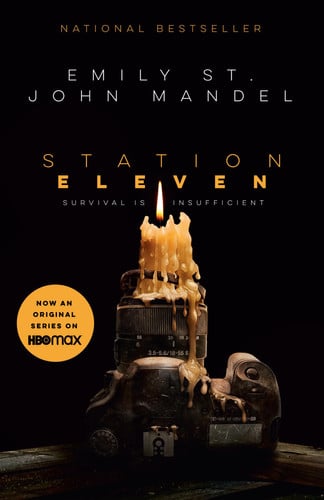
Twenty years later, the world is a skeletal landscape of abandoned towns and overgrown highways. Electricity is a forgotten marvel, and the remnants of humanity cling to small, scattered settlements. Through this quiet apocalypse travels the Symphony, a nomadic troupe of musicians and actors dedicated to bringing art to the survivors. Their motto, tattooed on an arm, speaks volumes: "Because survival is insufficient." Among them is Kirsten Raymonde, a child actor who was on stage with Arthur Leander the night he died. She carries with her two cherished copies of Miranda's "Station Eleven" comics, a tangible link to a world she barely remembers.
The Symphony's journey leads them through a perilous landscape, where dangers lurk not only in the wild but in the twisted ideologies that have taken root. They encounter the Prophet, a charismatic and dangerous leader who preaches that the pandemic was a divine cleansing, and who has a disturbing connection to Arthur Leander. He is, in fact, Arthur's son, Tyler, who, along with his mother Elizabeth, was stranded at the Severn City Airport at the onset of the flu. There, amidst the grounded planes, Arthur's best friend, Clark Thompson, began to curate a "Museum of Civilization," preserving relics of the vanished world – iPhones, laptops, credit cards – for a future that might never understand them.
The narratives intertwine, revealing the threads that connect these disparate lives across time and devastation. Arthur Leander, though long dead, remains a central figure, his life a nexus around which the survivors orbit. His regrets, his loves, his impact on those around him - all echo in the lives of Kirsten, Jeevan, Miranda, Clark, and the Prophet. The graphic novel, "Station Eleven," becomes a shared mythology, a touchstone for different characters, offering solace, inspiration, or, in the Prophet's case, a distorted scripture for his cult.
As the Symphony approaches the Severn City Airport, a confrontation with the Prophet becomes inevitable. The fragile hope of art and community clashes with the brutal certainty of his dogma. In a tense encounter, Kirsten faces the Prophet, her survival intertwined with the very stories she carries. The echoes of Arthur's past, particularly his kindness to a young Kirsten, play a crucial role in the ultimate resolution, demonstrating how even small acts of connection can ripple through time and provide unexpected salvation.
The journey culminates in a reunion at the Severn City Airport, a place where memories of the old world are meticulously preserved and new life slowly, tentatively, begins to flourish. The characters, each bearing the scars of loss and the resilience of survival, find moments of understanding and connection. The enduring power of art, memory, and human connection shines through the desolation, suggesting that even after the collapse, there remains a persistent, beautiful hum of humanity, forever striving for something more than mere existence.