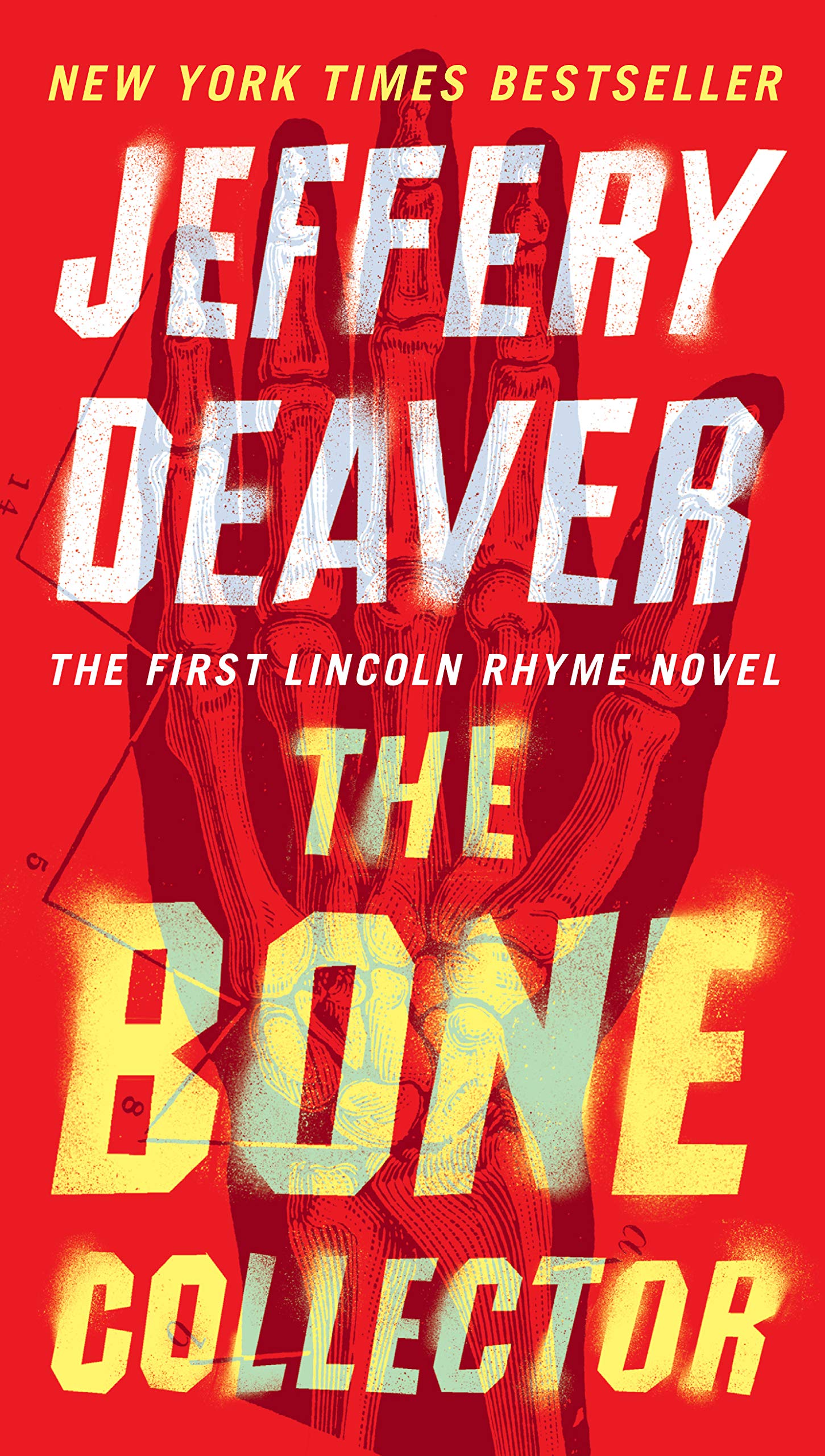
Lincoln Rhyme was once the country's leading forensic criminalist, his mind capable of uncovering any killer's secrets from the barest of clues. Now, an accident has left him a quadriplegic, a brilliant mind trapped inside a body that can only move one finger. Contemplating an end to his life, he is drawn back into the world he left behind when a sadistic serial killer begins terrorizing New York City. The killer, known only as the Bone Collector, stages elaborate kidnappings and murders, leaving a trail of arcane clues at each scene that point directly to the next victim.
To catch a killer, Rhyme must see the crime scenes, but he can't leave his bed. He must rely on Amelia Sachs, a young patrol officer haunted by her own past, to be his eyes, ears, and legs on the ground. Together, they form an unlikely partnership, entering a desperate race against time to decipher the Bone Collector's twisted messages before he strikes again. This intellectual duel between a paralyzed genius and a cunning murderer explores the power of the human mind to overcome any physical barrier in the relentless pursuit of justice.
The bustling, indifferent heart of New York City became the hunting ground for a predator unlike any other, a meticulous killer known only as "The Bone Collector." His gruesome artistry began with two unsuspecting colleagues, T.J. Colfax and John Ulbrecht, who vanished from a seemingly ordinary taxi ride, only for Ulbrecht to be discovered later, buried alive near train tracks, a single, flesh-stripped finger adorned with a diamond ring pointing skyward. This macabre scene, a chilling tableau of bone and metal, demanded a mind capable of deciphering its silent, terrifying language.
That mind belonged to Lincoln Rhyme, once the NYPD's most brilliant forensic criminalist, now a quadriplegic confined to a high-tech bed, his body shattered by a tragic accident years prior. He lived in a world of chronic pain and gnawing despair, contemplating an end to his suffering. Yet, the sheer audacity and forensic sophistication of the killer's first message ignited a spark in his dormant genius. Rhyme, despite his physical limitations, was pulled back into the fray, his sharp intellect and vast knowledge of crime scene investigation becoming the only weapons against this unseen enemy.
His eyes and hands in the field would be Amelia Sachs, a young, intuitive patrol officer on the verge of transferring out of patrol duty. It was Sachs who first stumbled upon Ulbrecht's grim discovery and, with an instinct that impressed Rhyme, secured the volatile crime scene. Reluctantly at first, she became his direct link to the physical world of the investigation, navigating the grimy, labyrinthine streets of New York, meticulously collecting evidence under Rhyme's remote, exacting guidance. Their partnership, an unlikely synergy of mind and body, began to forge itself in the crucible of escalating horror.
The Bone Collector, it became clear, was not merely a killer but a twisted historian, weaving elements of New York's dark past and forgotten spaces into his deadly game. Each crime scene was a meticulously staged riddle, a series of cryptic clues designed to challenge Rhyme, to draw him into an intellectual cat-and-mouse game. The killer left behind fragments of evidence - a piece of a antique map, a snippet of historical text, a unique knot - each a breadcrumb leading to the next victim, a desperate race against a ticking clock.
As Rhyme and Sachs delved deeper, the killer's motivations began to hint at something more personal, a vendetta that seemed to intertwine with Rhyme's own past. The clues, intricate and disturbing, pointed to a killer who was always one step ahead, intimately familiar with forensic techniques and the very city they were trying to save. The urgency intensified with each abduction, each grotesque discovery, forcing Rhyme to push the boundaries of his intellect and Sachs to confront the raw brutality of human depravity.
The chilling revelation finally emerged: the Bone Collector was none other than Peter Taylor, Rhyme's own doctor, whose true identity was Colin Stanton. Stanton, consumed by a deep-seated rage and grief, harbored a personal vendetta against Rhyme, blaming him for a past incident where a missed detail at a crime scene led to a shootout and the tragic loss of Stanton's family. His meticulously planned murders were not just a game, but a calculated act of revenge, culminating in a direct confrontation with the paralyzed criminalist.
In a climactic struggle, confined to his bed, Rhyme used the only weapon he had left - his raw, desperate will to survive. He managed to bite into Stanton's neck, severing an artery and mortally wounding the man who sought to destroy him. With the Bone Collector finally brought down, Rhyme, though still bound by his physical limitations, found a renewed purpose. The intellectual chase had reignited his passion for life and his work, solidifying his unique partnership with Amelia Sachs, a partnership that would continue to confront the darkest corners of the human psyche.
What other readers say
Liked
Reviewers largely praise The Bone Collector as a complex, intricately plotted, and utterly riveting police procedural and crime thriller. Many found it to be a compelling and fast-paced page-turner that kept them hooked, often reading late into the night. A significant highlight is the introduction of Lincoln Rhyme, a brilliant quadriplegic criminalist, whose ingenious mind and unique approach to solving crimes are widely admired. His dynamic partnership with Amelia Sachs, a beat cop who becomes his eyes and hands at crime scenes, is also frequently noted as a strong point, with readers enjoying their developing relationship and teamwork. The book is lauded for its extensive and surprisingly engaging detail regarding forensic investigation and crime scene analysis, making the scientific aspects fascinating rather than tedious for many. Additionally, the narrative is celebrated for its gripping suspense, numerous plot twists, and an unpredictable ending that few readers anticipate. For some, this book even sparked a lifelong love for reading or a new favorite series.
Disliked
Despite its strengths, the book comes with significant caveats, primarily concerning its graphic and often disturbing content. Numerous reviewers describe the narrative as sick, twisted, and brutal, with highly detailed depictions of violence and grisly crime scenes that caused some readers to put the book down or feel disgusted. Strong trigger warnings are frequently mentioned due to the extreme nature of the violence. Some critics also found aspects of the plot to be far-fetched or implausible, particularly concerning the killer's motivations, the compressed timeline of events, and certain actions attributed to the quadriplegic protagonist. While many appreciated the forensic detail, a minority found it excessive or "CSI-heavy." A few minor criticisms included antiquated character dialogue, some seemingly pointless stylistic choices, and one reviewer feeling the ending was a "bit weak." The protagonist, Rhyme, was occasionally perceived as unsympathetic or "all-knowing," and the description of Amelia Sachs's beauty was noted as an unnecessary detail by one reader.
In short
Overall, The Bone Collector is generally considered an outstanding and highly engaging crime thriller, with many readers calling it a masterpiece and a strong start to a series. Despite its significant graphic content and occasional narrative implausibilities, its compelling plot, unique characters, and detailed forensic work create a powerful reading experience. This book is best suited for readers who enjoy dark, intense police procedurals and detective stories, particularly those with a strong emphasis on forensic science and a race against time to catch a serial killer. It will appeal to those who appreciate intelligent, complex protagonists and dynamic partnerships, and who are not deterred by vivid, sometimes horrifying, descriptions of crime and violence. Readers should be prepared for a fast-paced narrative filled with suspense and unexpected turns.