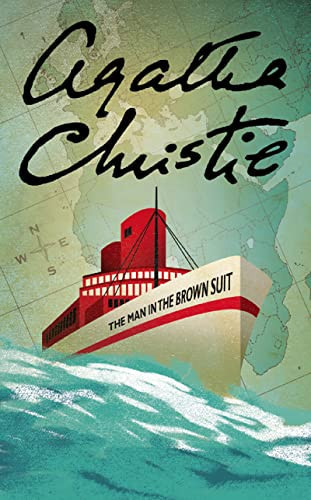
Newly orphaned Anne Beddingfeld arrives in London seeking adventure, only to find herself embroiled in a complex mystery almost immediately. She witnesses a man fall to his death at a tube station, an incident dismissed as accidental, yet a cryptic note left behind suggests otherwise. This clue, "17.1 22 Kilmorden Castle," links the death to a subsequent murder at a country estate where a mysterious man in a brown suit is implicated.
Driven by curiosity and a thirst for excitement, Anne embarks on a journey aboard the Kilmorden Castle, bound for South Africa. Her quest to uncover the truth leads her into a world of international espionage, stolen diamonds, and a shadowy criminal organization. As she navigates this dangerous landscape, Anne must rely on her wits to expose a web of deceit and survive the pursuit of a faceless killer.
Life for Anne Beddingfeld had been a quiet affair, tending to her scholarly father, but with his passing, a yearning for adventure stirred within her. London called, promising excitement, and it delivered almost immediately. One ordinary day at Hyde Park Corner tube station, a man, reeking faintly of mothballs, stumbled and fell onto the live railway track, dying instantly. The police ruled it an accident, but Anne's sharp eyes caught a fleeting glimpse of a mysterious man in a brown suit who briefly examined the body before vanishing into the crowd. Her curiosity piqued, she then found a cryptic note dropped nearby, bearing the words "17.1 22 Kilmorden Castle" and a house agent's order to view Mill House.
The very next day, a woman was found strangled at Mill House, and a man in a brown suit was seen fleeing the scene. The police dismissed Anne's suspicions about a connection between the two deaths, but she was undeterred. The clue "Kilmorden Castle" led her to discover it was the name of a ship bound for South Africa. With a daring spirit and scant funds, Anne booked passage, embarking on a journey that would plunge her into a world far more dangerous and thrilling than she could have imagined.
Aboard the ship, Anne encountered a fascinating array of characters: the elegant Suzanne Blair, the enigmatic Colonel Race (a British Secret Service agent), the seemingly jovial Sir Eustace Pedler, and his secretaries, one of whom was the very man in the brown suit she sought, Harry Rayburn. The journey was fraught with subtle tensions and hidden agendas. Anne, ever observant, began to piece together fragments of a larger conspiracy involving stolen diamonds and an international criminal mastermind known only as "the Colonel."
The adventure deepened upon arrival in South Africa, moving from the bustling streets of Cape Town to the wilder landscapes of Bulawayo and beyond. Anne found herself continually in peril, narrowly escaping attempts on her life, yet her resolve only hardened. She sought to clear Harry Rayburn's name, convinced of his innocence despite the mounting evidence against him. Her path crossed with Colonel Race repeatedly, sometimes as an ally, sometimes as a figure of suspicion, as the intricate web of espionage and theft unraveled.
Interspersed with Anne's thrilling narrative were excerpts from Sir Eustace Pedler's candid memoirs. These entries offered a contrasting, often humorous, perspective on the events, revealing his self-absorbed musings and occasional exasperation with the unfolding chaos around him. Though seemingly a mere observer, Sir Eustace's diary slowly unveiled deeper layers of his involvement, hinting at a connection to the shadowy organization Anne was pursuing.
The climax arrived on a remote island in the Zambezi, where the true identity of "the Colonel" was finally unmasked, revealing a shocking betrayal from within their own ranks. Anne, with remarkable courage and ingenuity, confronted the mastermind, bringing the diamond smuggling operation to its knees. Through twists and turns, true identities were revealed, and justice, though hard-won, ultimately prevailed. Anne not only solved the complex mystery but also found an unexpected romance amidst the danger, proving that adventure, indeed, had found her.
What other readers say
Liked
Many reviewers praise the book for its departure from Agatha Christie's typical whodunit format, offering a fast-paced thriller and adventure story instead. The protagonist, Anne Beddingfeld, is widely celebrated as a plucky, independent, clever, and brave heroine, embodying an authentic spirit of a 1920s woman. Readers enjoyed her perspective and found her one of Christie's most memorable characters. The narrative is described as highly enjoyable, fun, and a rollercoaster ride, often hooking readers instantly. The book's exotic settings, particularly the journey to and experiences in South Africa, are highlighted as major assets, creating a vivid and intriguing backdrop. The presence of engaging supporting characters, including the humorous Sir Eustace Pedler and the debonair Colonel Race, along with developing friendships and a heartwarming romance, also contributed positively to the reading experience.
Disliked
Despite its strengths, some readers found the book's divergence from Christie's traditional mystery style to be a drawback, noting it lacked the intricate plotting and clever reveals expected from her work. The plot itself was sometimes described as contrived, vague, or weakly developed, with the mystery occasionally taking a backseat to the adventure. Pacing issues were also mentioned, with some finding it a slow burn that struggled to sustain interest in the early chapters. While Anne Beddingfeld's spirited nature was appreciated, some reviewers found her actions occasionally immature, naive, or prone to glaring mistakes. The romance elements were sometimes perceived as cheesy or unconvincing, with Anne falling in love too quickly. Additionally, the role of Colonel Race often felt secondary. Several reviewers pointed out dated elements, including racial insensitivity, problematic views on colonialism, and certain character assessments that might be jarring to modern readers.
In short
Overall, The Man in the Brown Suit stands out as a unique and often polarizing entry in Agatha Christie's bibliography. While it may not satisfy those seeking her signature, intricately plotted whodunits, it offers a distinct and entertaining adventure thriller. The book is recommended for readers who enjoy a fast-paced narrative, exotic settings, and a spirited, independent heroine. It's particularly suited for Christie fans curious to explore her earlier, more action-oriented works, or anyone looking for a "rompy good time" with elements of mystery, espionage, and romance. Those who appreciate period fiction with a strong sense of its 1920s context, and are prepared for its dated cultural aspects, are likely to find this a highly enjoyable read.