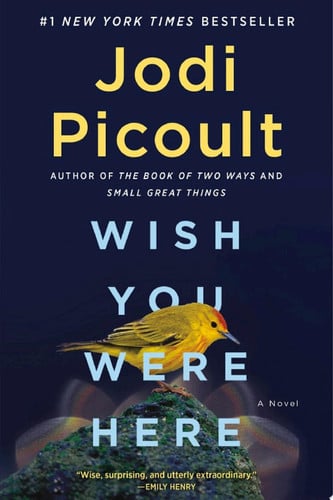
My life had a blueprint, a checklist I followed with the same diligence my father used to restore the constellations on the ceiling of Grand Central. I was an associate specialist at Sotheby's, on track for a promotion. My boyfriend, Finn, a surgical resident, was about to propose on our dream vacation to the Galápagos. It was March 13, 2020. But the city was growing quiet, a hush falling over the subways and theaters as a strange new virus whispered its way into our world. “Wash your hands and don't touch your face,” Finn told me. “It's going to be fine.” Then his hospital called for all hands on deck, and our blueprint dissolved. “Diana,” he said, his face etched with a worry I didn't yet understand, “you should still go.”
And so I went. The flight was a blur, my luggage was lost, and I landed on Isabela Island just as the last ferry was leaving. “La isla está cerrando,” the boatman said. The island was closing. In a defiant attempt to seem more adventurous than I was, I watched the boat of frantic tourists pull away, stranding myself in paradise. My hotel was shuttered, its doors locked against the pandemic and me. I had a toothbrush, a bathing suit, and the unnerving sense that I had just stepped off the edge of my own map. It was an old woman, her face a beautiful ruin of wrinkles, who found me. She patted her chest, “Abuela,” and led me to a small, empty apartment behind her own home, a place that backed right up to the ocean's edge.
Life on Isabela unfolded with the lazy rhythm of the tides. The days were measured by runs on the beach and the afternoon curfew that left the sandy streets deserted. I met Gabriel, a man as rough and beautiful as the island's volcanic rock, who seemed to resent my very existence as a tourist. And I met his daughter, Beatriz, a girl simmering with a silent, cutting grief. While I learned to navigate this strange new world of bartering for food and sketching portraits for supplies, I clung to the emails that trickled in from Finn, each one a dispatch from a war zone. He wrote of overflowing ICUs, of impossible choices, of the cacophony of ventilators and the crushing silence when a patient died alone. His reality felt a world away from mine, where my greatest challenge was communicating without a shared language and my greatest joy was watching sea turtles glide beneath the surface of a turquoise lagoon.
Slowly, the island's sharp edges softened. Gabriel's anger gave way to a shared vulnerability; he told me of the father he'd lost to the sea, the tragedy that had made him abandon his life as a tour guide. Beatriz, who at first kept me at a distance, began to trust me with the fragile pieces of her broken heart. On my thirtieth birthday, they threw me a party at Gabriel's unfinished farmhouse in the highlands. We ate cake and slept under a sky so thick with stars I could see constellations from both hemispheres. That night, by the fire, something shifted. “I thought I lost you,” Gabriel whispered to me weeks later, after pulling my breathless body from a riptide, his kiss a desperate, life-affirming anchor. He was a different future, a different life, one I had never planned for but was beginning to want. I was drowning, in the ocean and in him, when the world went black.
A voice pierced the darkness. “Hold on. Look at me. You're going to make it, Diana.” The light was blinding, the sounds a cacophony of beeps and whirs. A tube choked my throat. A man in a gown, gloves, and face shield held my hand, his eyes streaming with tears behind the plastic. It was Finn. He told me I'd been on a ventilator for five days. He told me I'd nearly died. He told me I was in a hospital in New York City. Confused, my voice a raw croak, I asked the only question that mattered. “Gabriel,” I rasped. “In the water… did he make it?” Finn's face clouded with a gentle pity. “Diana,” he said, his voice breaking. “You never went.”
My world split in two. In one, I was a Covid-19 survivor, a woman so ravaged by illness that her mind had created an elaborate, months-long hallucination to protect her from the trauma of her own body failing. I had never left New York. My mother, who I'd dreamed had died from the virus, was alive. My job was gone, furloughed along with thousands of others. This reality was a grueling climb back to life - relearning to walk, to swallow, to breathe without panic, each small victory a monumental effort. In this world, Finn was my hero, the man who had sat by my bedside, whispering his fears and his love into my unconscious ear, the man who had fought for my life.
But in the other world, the one that lived and breathed inside me with visceral clarity, I was a different person. I could still feel the grit of sand between my toes, the heat of Gabriel's hand in mine, the weight of Beatriz's head on my shoulder. These were not memories; they were experiences that had reshaped me. While my body healed in a rehab facility, my mind wrestled with the ghost of a life that felt more real than the one I was living. I was a survivor, yes, but I was grieving a man, a girl, and a version of myself that everyone told me never existed.
The city I returned to was not the one I had left. It was masked, scarred, and fearful, a collective mirror of my own recovery. Finn, my steady anchor, tried to pull me back to the blueprint of the life we had planned, but the foundation had cracked. He saw a woman who needed to be protected, a fragile patient. He didn't see the person who had learned to be resilient, to live without a map. One afternoon in Carl Schurz Park, surrounded by the tentative green of early summer, he knelt and asked me to marry him.
I looked at his earnest, loving face, the face I had dreamed of for years. And I saw the ghost of another man, another life, another me. “You can't plan your life, Finn,” I told him softly. “Because then you have a plan. Not a life.” It wasn't a choice between two men, but between two futures. I had to let go of the woman I was supposed to be to become the woman I was.
Years later, the ferry pulls up to Isabela Island. The air is warm, the sun is bright, and the world feels wide open. I step onto the dock, my bag rolling behind me, and a massive sea lion yawns in the sun, utterly unbothered by my arrival. Everything is at once unfamiliar and achingly recognizable. I walk past the tortoise pens, past the gnarled manchineel trees, my heart a frantic drum against my ribs. I don't know what I'm looking for, or what I'll find. I only know that I had to come. I am climbing over a low wall to right a baby tortoise that has flipped onto its back when a voice calls out, sharp and familiar. “Cuidado!” A hand grabs my wrist just before I fall. And I turn.