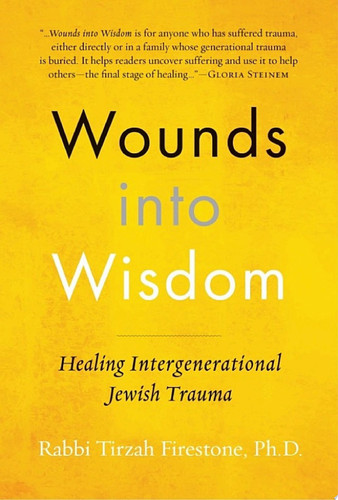
Wounds into Wisdom
8.32 / 10 140 ratings
- Language
- English
- Published
- 2019
- Publisher
- Monkfish Book Publishing
- Pages
- 237
- ISBN
- 9781948626033
Our past does not simply disappear; the painful history and rich cultural wisdom of ancestors intertwine within individuals, creating patterns for the future. Even when past trauma remains unspoken or has long been forgotten, it becomes a legacy of both strength and woundedness that shapes lives across generations. Tirzah Firestone, a rabbi and psychotherapist, explores the profound impact of this protracted historical trauma through compelling narratives, including her own family's story, alongside those of Israeli terror victims, Holocaust survivors, and individuals affected by racial persecution and displacement.
Firestone interweaves these testimonies with neuroscientific and psychological findings, along with relevant Jewish teachings, to demonstrate how trauma legacies can be transformed and healed. The book offers a roadmap for moving from suffering towards recovery, forgiveness, and moral leadership, distilling seven principles that provide prescriptive tools for anyone dealing with the effects of past injury. It provides a template for individuals and groups to emerge from the wreckage of tragedy and reshape their destinies, offering a path to uncover buried suffering and utilize it for growth and the benefit of others.
Firestone interweaves these testimonies with neuroscientific and psychological findings, along with relevant Jewish teachings, to demonstrate how trauma legacies can be transformed and healed. The book offers a roadmap for moving from suffering towards recovery, forgiveness, and moral leadership, distilling seven principles that provide prescriptive tools for anyone dealing with the effects of past injury. It provides a template for individuals and groups to emerge from the wreckage of tragedy and reshape their destinies, offering a path to uncover buried suffering and utilize it for growth and the benefit of others.
Subjects
- Self-Help
- History
- Social Sciences
- Judaism
- General Interests & Hobbies
- Self-Help General
- Psychology
- Religion
- Social Science
- Political Science
- Psychopathology
- Family & Consumer Sciences
- Abnormal Psychology
- 20th Century
- Modern
- Public Policy
- Family & Relationships
- Death, Grief, Bereavement
- Jewish Studies
- Social Services & Welfare
- Death & Dying
- Grief & Loss
- Holocaust
- Post-Traumatic Stress Disorder (PTSD)
- Religious Intolerance, Persecution & Conflict
Original edition
Wounds Into Wisdom Healing Intergenerational Jewish TraumaOriginally published in 2019 English Adam Kadmon Books/Monkfish Book Publishing Company
Other editions (3)
- Wounds Into Wisdom Healing Intergenerational Jewish Trauma: New Preface by Author, New Foreword by Gabor Maté, Reading Group and Study Guide
- Wounds into Wisdom Healing Intergenerational Jewish Trauma: New Preface from the Author, New Foreword by Gabor Mate (pending), Reading Group Guide
- Wounds Into Wisdom Healing Intergenerational Jewish Trauma
Listen to the summary Narrated summary
A profound understanding begins to dawn: the wounds of the past do not simply vanish with the passing generations. Instead, they echo through the present, shaping lives in ways often unseen, yet deeply felt. You come to realize that the raw, unaddressed suffering of ancestors - the terror of persecution, the devastation of the Holocaust, the relentless shadow of displacement - leaves an indelible imprint, not only in family narratives and learned behaviors but also, astonishingly, in the very expression of our DNA. This legacy, a complex tapestry of both inherited strength and deep woundedness, guides your journey into the intricate world of intergenerational trauma.
Through poignant personal stories and compelling interviews, you are introduced to the lives of those who carry these echoes: a young woman unknowingly repeating the exact words of her lost grandmother, an Israeli war hero haunted by decades of terrifying nightmares, families harboring secrets from their flight from Tehran. The very fabric of these lives reveals how extreme trauma alters us, not just individually, but collectively, leaving a profound mark on an entire people. You witness how the author's own family, with a mother who survived the Holocaust and a father who bore witness to its horrors as a soldier, became a testament to this enduring impact.
The journey delves into the fascinating intersection of modern neuroscience and ancient spiritual wisdom. You learn that what was once considered merely psychological is now understood to have biological roots, with epigenetics demonstrating how trauma can alter gene expression, creating a "biological memory" passed down through the family line. This scientific grounding merges seamlessly with the rich tapestry of Jewish wisdom, offering a unique lens through which to comprehend the enduring challenges faced by those carrying a history of collective suffering.
Yet, this exploration is not one of despair, but of profound hope. It unveils a powerful truth: while trauma changes us, we possess the agency to choose the outcome of our story. The path to healing is illuminated through seven guiding principles, distilled from the testimonies of survivors and their descendants. These principles invite you to courageously face your pain, to take decisive action, and to consciously shift from a perception of victimhood. They challenge you to resist the historical response of "othering" and to redefine concepts like "chosenness," transforming potential sources of further isolation into avenues for connection and strength.
You are shown that the work of healing is not a solitary endeavor. It thrives within an aware community, where others can witness, mirror, and offer support, reminding you that you can indeed change the narrative of your life. This transformative process involves deep inner excavation, a sensitive untangling of emotional and psychological knots, and the conscious garnering of wisdom from well and wise ancestors.
Ultimately, the message resonates: by engaging in this profound work, by transforming our inherited wounds, we not only heal ourselves but also contribute to the healing of future generations and the wider world. It is a call to moral awakening, an invitation to emerge from the wreckage of past tragedies, reclaim innate wisdom, and reshape destiny, offering a template for anyone seeking to turn suffering into profound understanding and liberation.
Through poignant personal stories and compelling interviews, you are introduced to the lives of those who carry these echoes: a young woman unknowingly repeating the exact words of her lost grandmother, an Israeli war hero haunted by decades of terrifying nightmares, families harboring secrets from their flight from Tehran. The very fabric of these lives reveals how extreme trauma alters us, not just individually, but collectively, leaving a profound mark on an entire people. You witness how the author's own family, with a mother who survived the Holocaust and a father who bore witness to its horrors as a soldier, became a testament to this enduring impact.
The journey delves into the fascinating intersection of modern neuroscience and ancient spiritual wisdom. You learn that what was once considered merely psychological is now understood to have biological roots, with epigenetics demonstrating how trauma can alter gene expression, creating a "biological memory" passed down through the family line. This scientific grounding merges seamlessly with the rich tapestry of Jewish wisdom, offering a unique lens through which to comprehend the enduring challenges faced by those carrying a history of collective suffering.
Yet, this exploration is not one of despair, but of profound hope. It unveils a powerful truth: while trauma changes us, we possess the agency to choose the outcome of our story. The path to healing is illuminated through seven guiding principles, distilled from the testimonies of survivors and their descendants. These principles invite you to courageously face your pain, to take decisive action, and to consciously shift from a perception of victimhood. They challenge you to resist the historical response of "othering" and to redefine concepts like "chosenness," transforming potential sources of further isolation into avenues for connection and strength.
You are shown that the work of healing is not a solitary endeavor. It thrives within an aware community, where others can witness, mirror, and offer support, reminding you that you can indeed change the narrative of your life. This transformative process involves deep inner excavation, a sensitive untangling of emotional and psychological knots, and the conscious garnering of wisdom from well and wise ancestors.
Ultimately, the message resonates: by engaging in this profound work, by transforming our inherited wounds, we not only heal ourselves but also contribute to the healing of future generations and the wider world. It is a call to moral awakening, an invitation to emerge from the wreckage of past tragedies, reclaim innate wisdom, and reshape destiny, offering a template for anyone seeking to turn suffering into profound understanding and liberation.
What other readers say
Liked
This book is widely praised as an intellectually stimulating, compelling, and easy-to-read exploration of individual, familial, and cultural traumas, particularly within the Jewish community. Readers frequently highlight its ability to synthesize biological and social science with anecdotal narratives, leading to profound personal insights and "aha" moments as they recognize their own experiences reflected in the text. Many found the book to be full of wisdom, offering practical tools and principles for healing intergenerational wounds and transforming pain into positive growth. It is considered an essential contribution to vital discussions about trauma's long-term implications and pathways to a thriving future.
Disliked
However, some readers noted that the book's structure could feel uneven. The second half, which applies healing principles to broader contexts such as the Israeli-Palestinian conflict, was perceived by some as a departure from the initial focus, making it feel like "two different books." While this application was appreciated by many for its depth, others found it unexpected or wished for a more consistent narrative flow. Additionally, certain healing concepts, like turning victimhood into social responsibility, were sometimes seen as predictable for readers already familiar with progressive Jewish thought. For professionals in the trauma field, the research presented, though well-sourced, might be largely familiar, making the book more of a primer than a source of novel academic insights.
In short
In conclusion, "Wounds into Wisdom" is largely viewed as a meaningful and informative work that offers profound insights into the experience of intergenerational trauma and outlines hopeful pathways to recovery. It is highly recommended for anyone interested in the psychology of trauma, particularly those seeking to understand its impact within Jewish families and communities. While its specific applications to geopolitical conflicts might resonate more with certain audiences, the book generally serves as a valuable resource for readers looking to confront historical burdens, foster compassion for their family's past, and contribute to breaking cycles of inherited pain.
No reviews yet. Be the first.