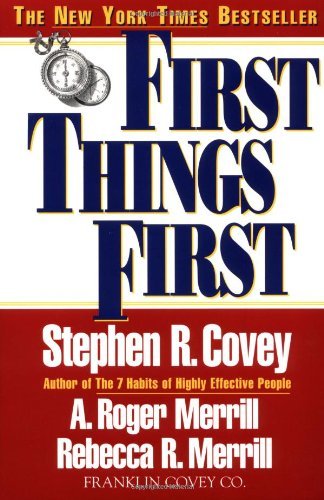
Many time management systems focus on doing more things faster, often leading to a feeling of being busy without being effective. "First Things First" presents an alternative approach, shifting the focus from the clock to the compass. This book guides readers to prioritize what is truly important in their lives rather than merely reacting to what is urgent.
It introduces a framework for aligning daily actions with deeply held principles and long-term goals, encouraging a life centered on values rather than immediate pressures. By understanding the distinction between urgency and importance, readers can gain control over their schedules, foster meaningful relationships, and work towards a more balanced and purposeful existence. This approach offers a pathway to a life where what matters most is not only accomplished but also integrated into the very fabric of one's daily routine.
There is a profound distinction between merely being busy and truly being effective, a difference often obscured by the incessant demands of modern life. We find ourselves driven by the ticking clock, caught in a whirlwind of appointments, deadlines, and urgent tasks, yet a deeper yearning persists - a desire to live a meaningful life, guided by our internal compass, our values, and our vision. The challenge lies in bridging the gap between what we do and what truly matters most to us.
Traditional time management systems often focus on efficiency, on doing more things faster. But the real issue isn't about speeding up; it's about doing the right things, the important things, not just the urgent ones. Imagine your life as a jar. If you fill it first with tiny pebbles and sand - the countless urgent but often unimportant tasks - there will be no room left for the big rocks: the truly significant priorities that nourish your spirit and propel your long-term growth. The key, then, is to place the big rocks first, intentionally scheduling those vital, non-urgent activities that define your purpose.
To navigate this terrain, we must understand the "Time Management Matrix," a framework that categorizes all activities based on two criteria: urgency and importance. Quadrant I holds tasks that are both urgent and important - crises, pressing problems, genuine emergencies. Quadrant III contains activities that are urgent but not important - interruptions, some emails, demands that feel pressing but contribute little to your core mission. Quadrant IV is for those neither urgent nor important distractions and time-wasters. The true power, however, lies in Quadrant II: activities that are important but not urgent.
Quadrant II is the realm of proactive planning, prevention, relationship building, recognizing new opportunities, and personal renewal. These are the activities that, if consistently attended to, would dramatically improve your life and work, reducing the number of crises that land in Quadrant I. Yet, because they lack immediate deadlines, these crucial tasks are often neglected, sacrificed at the altar of urgency. It is here, in Quadrant II, that true effectiveness, personal growth, and lasting peace of mind are cultivated.
Our deepest human motivations are to live, to love, to learn, and to leave a legacy. A life lived in alignment with these profound needs is a life of quality. If any of these fundamental aspects - our physical well-being, our connections with others, our mental development, or our sense of purpose - are consistently unmet, our overall quality of life diminishes. By consciously dedicating time to Quadrant II activities, we feed these essential capacities, ensuring a balanced and fulfilling existence.
Sustainable effectiveness also hinges on the "P/PC Balance." "P" stands for Production, the desired results or the "golden eggs" you seek. "PC" stands for Production Capability, the asset or ability that produces those results - the "goose" that lays the golden eggs. Often, we push relentlessly for more "P," neglecting the "PC" by sacrificing our health, relationships, or continuous learning. This imbalance inevitably leads to burnout and a diminished capacity to produce anything of value in the long run. True effectiveness demands that we invest in and nurture our production capability, ensuring the goose remains healthy and continues to lay.
To begin this transformation, dedicate time each week, perhaps 30 minutes, to align your clock with your compass. Identify your key roles in life - as an individual, a partner, a parent, a professional, a community member - and for each role, determine one or two important, non-urgent Quadrant II goals for the upcoming week. These are your "big rocks." Then, schedule these priorities into your week first, before the urgent demands of others or the trivial distractions claim your time. This deliberate act of scheduling your priorities, rather than prioritizing what's already on your schedule, empowers you to lead your life with intention, purpose, and profound effectiveness.
What other readers say
Liked
The book is widely praised as a profoundly helpful and inspiring guide, offering a transformative approach to managing priorities and living a more satisfying life. Many readers found its core concept of distinguishing between urgent and important tasks, particularly the focus on "Important, Not Urgent" activities, to be an epiphany that shifts perspective from mere time management to effective priority management. It is lauded for providing a thought-provoking model for living by principles rather than being driven by a to-do list, challenging conventional daily structures to foster a more peaceful and fulfilling existence. Reviewers highlight its ability to instill a sense of inner peace, psychological balance, and to help individuals discover their internal compass, guiding them towards long-term results. The book is seen as a comprehensive framework, moving beyond older time management methods to a modern approach that prioritizes quality over quantity and nurtures crucial relationships, offering practical solutions and a deep, spiritual dimension to personal development.
Disliked
Despite its strengths, several reviewers found the book to be excessively verbose, repetitive, and unnecessarily lengthy, suggesting that its core message could be conveyed in a much shorter format. Critics noted that it often takes a long time to get to the point, with some chapters being described as boring or "fluff." There's a common sentiment that while the intentions are good, the practical application of some concepts, particularly the "fluffy terminologies" like "Mission Statement" or "Leaving a Legacy," might be challenging for average individuals or those in demanding work environments, potentially seeming irrelevant to immediate struggles. Some also felt the book provides "what" to do but lacks sufficient guidance on "how" to implement the strategies. Additionally, the Kindle version specifically received criticism for poor formatting, missing diagrams, and a general lack of editing, making it a frustrating read for digital users.
In short
Overall, "First Things First" is considered a highly impactful book that offers a holistic, principle-centered approach to life management, moving beyond simple task completion to deep personal effectiveness. It is strongly recommended for a broad audience, including young adults, individuals feeling overwhelmed by daily demands, those in supervisory or leadership roles, and anyone seeking to align their daily choices with their core values and long-term goals. The book is particularly beneficial for readers who are fascinated by productivity and self-improvement, or who already have some life structure but wish to manage their priorities with greater intentionality and balance. While its length and occasional repetition might require patience from some readers, its profound insights into living a life driven by purpose rather than urgency make it a worthwhile read for those committed to personal growth and achieving a more integrated, fulfilling existence.