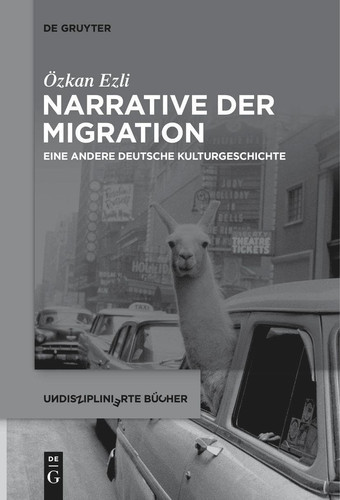
I have found that "Narrative der Migration Eine andere deutsche Kulturgeschichte" by Özkan Ezli is a postdoctoral thesis that seeks to write the cultural history of German immigration society, which has largely been unwritten despite significant interactions and aesthetic negotiations in literature, film, and societal debates since the 1960s. The work provides an unexpected perspective on informal relationships and potentials that have previously received little attention.
The table of contents (from a preview) shows a chronological progression through different decades, each characterized by a core question related to migration:
Chapter 2: "Wir wollten alle Amerikaner werden": Der Gast und seine Arbeiter (We all wanted to be Americans: The Guest and his Workers) focuses on the 1960s, discussing "simple stories" and the search for an "unfindable partner," with Aras Ören's "Gastarbeiter" being mentioned.
Chapter 3: "Wie lebt es sich als Türke in Deutschland?": Der Ausländer und sein Volk oder das Recht auf Repräsentation. Literatur, Film und Politik in den 1980er Jahren (How does one live as a Turk in Germany?: The Foreigner and his People or the Right to Representation. Literature, Film and Politics in the 1980s) delves into the complexities of representation and "blocked integrations."
Chapter 4: "Wie lebt es sich in Deiner Haut?": Von der Herkunfts- zur Konfliktgesellschaft in Literatur, Film und Debatten der 1990er Jahre (How does one live in your skin?: From a Society of Origin to a Society of Conflict in Literature, Film and Debates of the 1990s) explores themes of survival in society, culture as a question of "dwelling," and the impossibility of a "third space."
Chapter 5: "Was lebst Du?": Narrative der Ankunft und Integration (What are you living?: Narratives of Arrival and Integration) considers culture as a resource and the arrival in the majority society.
The book argues that neither the narrative of successful German integration into the West nor the current post-migrant society framework fully explains how Germany became an immigration society after the "break of civilization." Instead, it traces the historical sequence of these aspects, sediments, and areas – from literature and film to integration debates, social scientific works, and legal discussions – to make the cultural history of German immigration society visible. This history, it suggests, is marked by disrupted communications, aborted political processes, and shifting structures and practices of encounter. Ezli's work challenges the idea that migration is an anomaly, suggesting that to be human is to be in transit.
I have a good overview of the book's structure, its central thesis, and the progression of its arguments through different decades, using literature and film as key lenses. I also understand the author's underlying perspective on migration as a fundamental aspect of human existence and its impact on German society. I have enough information to construct a detailed summary that aims to immerse the reader in the book's message and style.